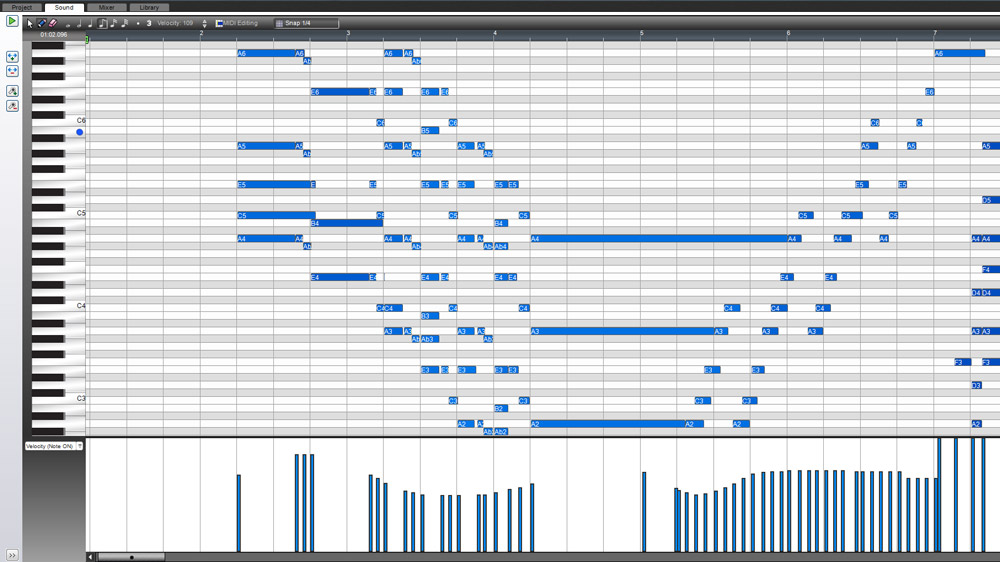
RB AND Sonar/Cakewalk both feature PianoRoll MIDI entry and editing.
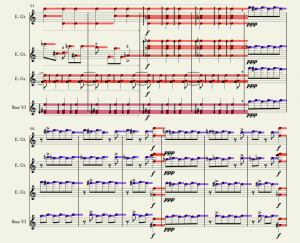
I'm not a big proponent of MIDI sequencing via Notation, because notation simply cannot easily provide enough of the necessary entry paramaters. For example, a trained live musician inherently knows the various rulesets involved with how long a Quarter Note or 8th should be played within the given situation. Notation entry, on the other hand, will yield all Quarter Note values as dead equal and that is not inherently a good sounding musical representation.
By far my most favorite method of MIDI part implementation is Recording to the click in realtime using a MIDI Controller of some sort, though. That delivers a performance that will sound exactly like what you played when you played it, yet offers the note-level Editing of MIDI when needed for cleanup and such.
Midi production and editing in Reaper is excellent. It's something that's been developed significantly over the last couple of years. I use it regularly.
The MIDI engine inside today's Sonar is pretty much the exact same and good MIDI engine that many of us came to know and love from back in the days of Greg Hendershot's original Cakewalk. ... --Mac
I concur. I would add that the SONAR X series (X1, X2 and X3) has now given us a smart tool that adapts quicker to what you want to do when editing MIDI.
BIAB 2026 Win Audiophile. Software: Fender Studio One 8, Swam horns, Acoustica-7, Notion 6, Song Master Pro, Win 11 Home. Hardware: Intel i9, 32 Gb; Fender Quantom HD8 & Faderport 8, Royer 121, Adam Sub8 & Neumann 120 monitors.
Matt, can you advise which program you like to use for Notation editing? I agree with the comment from Rich that MIDI editing in RB is somewhat cumbersome compared to other programs. Thanks Trevor
Trevor, I haven't used RealBand so I can't compare, but as to Notation programs, I have used Encore for 23 years. I have also been a beta tester for them for the last decade. I love the user interface in Encore (though I still use BIAB for most data entry!).
Although I have used Sibelius and Finale, I don't like their user interface by comparison to Encore, and only use them when I am forced to.
BIAB 2026 Win Audiophile. Software: Fender Studio One 8, Swam horns, Acoustica-7, Notion 6, Song Master Pro, Win 11 Home. Hardware: Intel i9, 32 Gb; Fender Quantom HD8 & Faderport 8, Royer 121, Adam Sub8 & Neumann 120 monitors.
Another +1 for Sonar. I do extensive MIDI editing and Sonar X3d is the easiest to use IMO. I use the piano roll view (PRV) to do most of my editing. I find that much easier than using the notation view. However I use the notation view when I hear something not quite right as it is easier for me to see there than in the PRV. For example hearing an F someplace during a D chord and knowing that it is not suppose to be there.
Good luck in your search.
Life is short so make sure you spend as much time as possible on the Internet arguing with strangers.
64 bit Win 10 Pro, the latest BiaB/RB, Roland Octa-Capture audio interface, a ton of software/hardware
RB AND Sonar/Cakewalk both feature PianoRoll MIDI entry and editing.
I'm not a big proponent of MIDI sequencing via Notation, because notation simply cannot easily provide enough of the necessary entry paramaters. For example, a trained live musician inherently knows the various rulesets involved with how long a Quarter Note or 8th should be played within the given situation. Notation entry, on the other hand, will yield all Quarter Note values as dead equal and that is not inherently a good sounding musical representation.
By far my most favorite method of MIDI part implementation is Recording to the click in realtime using a MIDI Controller of some sort, though. That delivers a performance that will sound exactly like what you played when you played it, yet offers the note-level Editing of MIDI when needed for cleanup and such.
--Mac
I agree with this 100%. Step entry or notation based entry is tedious at best, and stressful at worst for me.
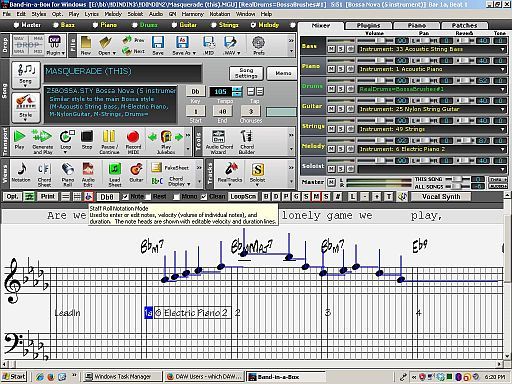
I like PG's implementation of a hybrid for post-fat-fingered-recorded-mistake editing. I can read note values much more quickly; instantly honestly, on staff than I can with alternating colors on a piano roll display. I guess an analogy would be the difference between the standard block lettering found on an engineering drawing, versus the same drawing with cursive writing on it.
Alternatively, take a look at Mixcraft's piano roll - the head of each note bar on the roll is identified with pitch value. Zoomed out, this could be a mess, but zoomed in, for precise midi note editing, a nice way of going about displaying pitch value directly. Surely they can't be the only folks that do this.
In doing a little bit more research, it appears that a program called 'Notion' also implements a PG like hybrid between staff notation and 'bars and pipes'.
BB, RB and PT also have the excellent StaffRoll view, very handy for quickly editing Note placements, Velocities and Durations quickly.
I couldn't find that screenshot - that, in my opinion is the best post-recorded midi editing representation available. Are all PG programs like that? If so, IMO that's the high water mark, for editing.
Yes, the Staff Roll Notation Mode of editing can be quite useful.
BIAB & RB2026 Win.(Audiophile), Windows 10 Pro & Windows 11, Cakewalk Bandlab, Izotope Prod.Bundle, Roland RD-1000, Synthogy Ivory, Session Keys Grand S & Electric R, Kontakt, Focusrite 18i20, KetronSD2, NS40M, Pioneer Active Monitors.
I'll point out that you can paint yourself into a corner by trying to use only one of the MIDI editing/entry methods for all tasks.
Find out which method does a specified task the easiest, or the fastest, or in the most logical fashion for you and don't be afraid to switch between Notation, Staff Roll or PianoRoll views, also don't neglect MIDI Monitor and the other fine MIDI event editing tools as well.
I often prefer Piano Roll, and Event List edits for finer adjustments, especially for note position and velocity. Piano Roll is great if you want to say move a selected group of notes by an octave, third etc.
Like you say, all have a place somewhere or other.
BIAB & RB2026 Win.(Audiophile), Windows 10 Pro & Windows 11, Cakewalk Bandlab, Izotope Prod.Bundle, Roland RD-1000, Synthogy Ivory, Session Keys Grand S & Electric R, Kontakt, Focusrite 18i20, KetronSD2, NS40M, Pioneer Active Monitors.
I use Cubase Le4, with a Zoom R16 as my controller. It is the DAW that came with the Zoom; before that I used Real Band exclusively, but I like being able to move the faders with the Zoom in real time, I can also mute and solo outside the box. I wish Real Band would add Zoom controller to their list. I liked real band!
I use Mixcraft 6 because it was suggested to me by members of one of the Shadows´sites that I use to post on !:) It handles midi pretty nicely and it was very affordable too !:))
Even when brand spankin', the maintenance was near continuous.
The old analog decks DID sound wonderful with electric guitars, though, but don't for one second succumb to the idea that one can expect it to perform as designed from day to day without either being able to electrically, electronically and mechanically perform the necessary repairs and adjustments needed from day to day themselves, or have enough cash overhead available at all times to hire someone who can.
Guys who show up in lab coats who have German or Swedish sounding first names, speak little English - until it come time to fill out the Invoice for Services Rendered.
And don't try to find fresh reels of good magnetic tape for the things now, either. Today we are down to one $ource...
zplane recently interviewed Peter Gannon, the founder and creator of Band-in-a-Box, about the software's early days, what sets it apart from AI, how zplane's audio algorithms are used in Band-in-a-Box, and more!
Special thanks to the team at zplane for their continued support.
Last Chance! The Band-in-a-Box® 2026 for Mac® Special Ends Today (May 31, 2026) at 11:59pm PDT!
Time really is running out! Save up to 50% on Band-in-a-Box® 2026 for Mac® upgrades and receive a FREE Bonus PAK—only when you order by 11:59 PM PDT today!
We've added many major new features and new content in a redesigned Band-in-a-Box® 2026 for Mac®!
Version 2026 introduces a modernized GUI redesign across the program, with updated toolbars, refreshed windows, smoother workflows, and a new Dark Mode option. There’s also a new side toolbar for quicker access to commonly used windows, and the new Multi-View feature lets you arrange multiple windows as layered panels without overlap, making it easier to customize your workspace.
Another exciting new addition is the amazing new AI-Notes feature, which can transcribe polyphonic audio into MIDI. View the results in notation or play them back as MIDI, and choose whether to transcribe an entire track or transcribe specific parts like drums, bass, guitars/piano, or vocals. There's over 100 new features in Band-in-a-Box® 2026 for Mac®.
There's an amazing collection of new content too, including 202 RealTracks, new RealStyles, MIDI SuperTracks, Instrumental Studies, “Songs with Vocals” Artist Performance Sets, Playable RealTracks Set 5, two RealDrums Stems sets, and much more!
Upgrade your Band-in-a-Box for Mac® to save up to 50% on most Band-in-a-Box® 2026 upgrade packages!
Plus, when you order your Band-in-a-Box® 2026 Mac upgrade during our special, you'll receive a Free Bonus PAK of exciting new add-ons.
If you need any help deciding which package is the best option for you, just let us know. We are here to help!
Band-in-a-Box® 2026 Mac Special Offers Extended Until May 31st!
Good news- we've extended our Band-in-a-Box® 2026 for Mac® special offers until May 31, 2026!
Band-in-a-Box® 2026 is packed with major new features, enhancements, and an incredible lineup of new content! The program now sports a sleek, modern GUI redesign across the entire interface, including updated toolbars, refreshed windows, smoother workflows, a new dark mode option, and more. The brand-new side toolbar provides quicker access to key windows, while the new Multi-View feature lets you arrange multiple windows as layered panels without overlap, creating a flexible, clutter-free workspace. We have an amazing new “AI-Notes” feature. This transcribes polyphonic audio into MIDI so you can view it in notation or play it back as MIDI. You can transcribe an entire track (all pitched instruments and drums) or focus on individual parts like drums, bass, guitars/piano, or vocals. There's an amazing collection of new content too, including 202 RealTracks, new RealStyles, MIDI SuperTracks, Instrumental Studies, “Songs with Vocals” Artist Performance Sets, Playable RealTracks Set 5, two RealDrums Stems sets, and much more!
There are over 100 new features in Band-in-a-Box® 2026 for Mac®.
When you order purchase Band-in-a-Box® 2026 before 11:59 PM PDT on May 31st, you'll also receive a Free Bonus PAK packed with exciting new add-ons.
Check out the Band-in-a-Box® for Mac packages page to find the best package for you.
Today's the Last Day of the Band-in-a-Box 2026® for Mac Special!
Order before 11:59pm PDT today (May 15, 2026) to save up to 50% off your Band-in-a-Box® 2026 for Mac® upgrade and receive a FREE Bonus PAK loaded with great new Add-ons to use with this new version!
Band-in-a-Box® 2026 for Mac - Special Offers End at 11:59pm PDT on Friday, May 15th, 2026!
Order before 11:59pm PDT on Friday, May 15th and SAVE up to 50% on most Band-in-a-Box® version 2026 for Mac Upgrade packages... and that's not all! With your version 2026 for Mac purchase, we'll include a Bonus PAK full of great new Add-ons FREE! Upgrade to the 2026 49-PAK to receive even more NEW Add-ons including 20 additional RealTracks... that's 222 NEW RealTracks available with version Band-in-a-Box® 2026 for Mac!
Upgrade to Band-in-a-Box® 2026 for Mac® today for as little as $49! Check out the Band-in-a-Box® packages page for all available purchase options.
Learn more about the Free Bonus PAK and 49-PAK here.
If you have any questions about which package is the best option for you, just let us know. We're here to help!
202 New RealTracks Released with Band-in-a-Box 2026!
With Band-in-a-Box® 2026, we've released 202 incredible new RealTracks (in sets 468-488) in a variety of genres—featuring your most requested styles!
Jazz, Funk & World (Sets 468-475):
Our new jazz, funk & blues RealTracks include a groovin’ collection of RealTracks and RealDrums! These include more requested “soul jazz” RealTracks featuring artists Neil Swainson (bass), Charles Treadway (organ), Brent Mason (guitar), and Wes Little (drums). There are new “smooth jazz” styles (4), which include a RealTracks first: muted trumpet, as well as slick new smooth jazz brushes options for drums. Blues lovers will be thrilled—there are more “classic acoustic blues” styles, including guitar (5), bass (4), and drums (10) with blues master Colin Linden, featuring understated and tasty background acoustic soloing, plus brushes drums and acoustic bass. There are also new electric blues RealTracks, including electric blues with PG favorite Johnny Hiland (3) and soulful electric slide guitar from Colin Linden (4). If you love funk & gospel, there are great new options this year, including gospel organ (3) from Charles Treadway, as well as new funk, tango, and rock ’n’ roll drums (3) and bass (1). And for big, bold arrangements, we have uptempo soul horns (4) featuring a three-part hip horn section with options for a full mix or stems of each individual horn — plus an accompanying rhythm section (4) of drums, bass, guitar, and electric piano!
Rock & Pop (Sets 476–482):
Our new rock & pop RealTracks bring a powerful mix of requested favorites, fresh genres, and modern chart-inspired styles! We have more of our popular “Producer Layered Acoustic Guitars (15)” featuring Band-in-a-Box favorite Brent Mason. We’ve continued our much-requested disco styles (10), and added new Celtic guitar (5) with a more basic, accessible approach than our previous Drop-D or DADGAD offerings. There are also highly requested yacht rock styles (17), inspired by the smooth, polished soft-rock sound of the late ’70s and early ’80s — laid-back grooves, silky electric pianos, warm textures, elegant harmonic movement, and pristine production aesthetics. Fans of heavier styles will love our new glam metal (13), capturing the flashy, high-energy sound of ’80s arena-ready guitar rock. We also have a set of rootsy modern-folk rock (18), with a warm, organic sound combining contemporary folk textures and driving acoustic strumming. And we’ve added lots of new modern pop styles (16) — the kinds of sounds you’re hearing on the radio today, featuring exciting new drums, synths, and cutting-edge RealTracks arrangements.
Country, & Americana (Sets 483–488):
Our new country & Americana RealTracks deliver a rich collection of acoustic, electric, and roots-inspired styles! We have new country pop (9) with legendary guitarist Brent Mason. There is also a potpourri (14) of bouzouki, guitars, banjo, and more, perfect for adding texture and character to contemporary acoustic arrangements. We’ve added funky country guitar (5) with PG favorite Brent Mason, along with classic pedal steel styles (5) featuring steel great Doug Jernigan. There are more country songwriter styles (8) that provide intimate, rootsy foundations for storytelling and modern Americana writing. Finally, we have “background soloing” acoustic guitar (12) with Brent Mason — simpler, but still very tasty acoustic lines designed to sit beautifully behind vocals or act as a subtle standalone solo part.
And, if you are looking for more, the 2026 49-PAK (for $49) includes an impressive collection of 20 bonus RealTracks, featuring exciting and inspiring additions to add to your RealTracks library. You'll get new country-rhythm guitar styles from PG Music favorites Johnny Hiland and Brent Mason, along with modern-pop grooves that capture today’s radio-ready sound! There are also new indie-folk styles with guitar, bass, 6-string bass used as a high-chording instrument, acoustic guitar, and banjo. Plus, dedicated "cymbal fills" RealDrums provide an added layer that work very well with low-key folky styles with other percussion.
The 2026 49-PAK is loaded with other great new add-ons as well. Learn more about the 2026 49-PAK!
One of our representatives will be happy to help you over the phone. Our hours of operation are from
6:00AM to 6:00PM PST (GMT -8) Monday thru Friday, and 8:00AM to 4:00PM PST Saturday. We are closed Sunday. You can also send us your questions via email.
One of our representatives will be happy to help you on our Live Chat or by email. Our hours of operation are from
6:00AM to 6:00PM PST (GMT -8) Monday thru Friday; 8:00AM to 4:00PM PST (GMT -8) Saturday; Closed Sunday.









 Dansk
Dansk Deutsch - Windows
 Español
 Français - Windows
 Italiano - Windows
 Nederlands
 Polski
 Português
 Svenskt
 русский
 Japanese
 Simplified Chinese
 Traditional Chinese
 Korean