This is as good a place as any to post bug reports..... however, be sure, first of all, that it is a bug and not just something you haven't yet figured out or learned yet.
Most often, the bugs are most prevalent in the first new yearly release and get fixed in the subsequent "updates" in the first quarter of the year, so by now, they are all (mostly) fixed if you have the most recent upgrade applied.
So, as Noel asked... what seems to be the issue?
You can find my music at: www.herbhartley.com Add nothing that adds nothing to the music. You can make excuses or you can make progress but not both.
The magic you are looking for is in the work you are avoiding.
I know, everyone hates newbies, they ask all the same questions... But I searched and didn't see it. Where do I post bug reports?
Thanks!
Willy.
Willy, one little correction: As far as I can tell, nobody here dislikes newbies. Everyone starts somewhere. Welcome to this great forum. There's some great members with stacks of knowledge who are willing to help and share ideas. You've already had a reply from a couple of them.
Trevor
BIAB & RB2026 Win.(Audiophile), Windows 10 Pro & Windows 11, Cakewalk Bandlab, Izotope Prod.Bundle, Roland RD-1000, Synthogy Ivory, Session Keys Grand S & Electric R, Kontakt, Focusrite 18i20, KetronSD2, NS40M, Pioneer Active Monitors.
Okay, so here's one: 1. Downloaded Sultans of Swing from Amazon and had the Audio Chord Wizard turn it into chords for me. It made a decent stab at it, but got a lot of things wrong, D vs. Dm, too many 7s and sus's that kind of thing, but it's hard and I don't take that as a bug. 2. So I sent it back to biab and it got the key wrong, it thought it was in F and most of you know it's in Dm. Okay, not a problem, there are F chords in there after all. 3. Spent a lot of time getting all the chords right, but eventually things are okay. I then tried using the song form to put in ABCBCCCCD, and that worked okay, but it did nothing visible. When I tried to use it to auto-generate repeats it said it couldn't do it, so I put all the repeats in by hand. 4. Had a glitch when trying to put it back into ACW and when I sent it back to biab a second time, it wiped out all the chords, changed the first chord and the key to F and that was that. But now I can't reproduce that one, so okay. 5. Now I tried to enter the lyrics in Notation mode. First off, why so large and why only two bars at a time even when I change the font smaller? Anyway, I use line mode next since I don't have a melody line. 6. Second, if I do anything other than type text, the cursor goes back to the start of the line. Click on the notation line for example, then click back where you left off typing, and what you type starts at the start of the line. I think you can fix it by clicking twice on the spot you want to start typing again, but it is a bit cumbersome. 7. Next if you are done typing for the current two bars you can't go to the next two bars using the arrow keys. You first have to ckick on the staff area and then hit right-arrow. Then you have to click on the text bar again. I can't say I had a good time doing this but eventually I got lyrics entered all the way to bar 128. 8. Here's where it gets unhappy. I tried entering text for bar 129 or 130, and the other bar next to it, and then went to the next couple of bars only to find the same text I just typed already there! In fact the same text was now copied to the rest of the song, from bar 130 to the end (bar 213 or so). I never managed to put the rest of the lyrics in.
Enough for now, does any of that sound familiar? Don't get me wrong, it makes very nice accompaniment, using the Real Tracks country style with pedal steel right now, but I thought things should be a little essier than what I encountered so far... and I just got started...:-)
You really did start at the deep end. If I was a new user, I would've been happy at about step 3...
BIAB & RB2026 Win.(Audiophile), Windows 10 Pro & Windows 11, Cakewalk Bandlab, Izotope Prod.Bundle, Roland RD-1000, Synthogy Ivory, Session Keys Grand S & Electric R, Kontakt, Focusrite 18i20, KetronSD2, NS40M, Pioneer Active Monitors.
Firstly, regarding the size of the notation editor window and the 2 bar display.
To change the size of the window, enter into Notation Mode and click on the "-" sign I've highlighted with a yellow circle below.
Secondly, to adjust the number of bars in the display, again enter Notation Mode. This time, click on the "Opt" on the left upper side of the stave. I've highlighted the setting to adjust.
Regarding point #4 in your post (losing the chords when sending the song back to BIAB a second time).
This is correct behaviour. The programming assumes that when you send the song to BIAB, you have finished with the ACW. Next time you use the ACW, BIAB will assume it's a new song and overwrite what is on the chord sheet.
Personally, I always save multiple copies of songs so that I can get back to a previous working version if needed.
F is the relative major of Dm - both have Bb in the key signature. I'll have to do some experimenting here because I'm not sure how accurately ACW differentiates between minor keys and their relative major.
To be fair to ACW, there is nothing that really identifies "Sultans of Swing" as being necessarily in D minor. The C and Bb chord are much more appropriate to F major than D minor and there is no Gm chord that I'm aware of (chord IV in the key of D minor) to help the identifying process.
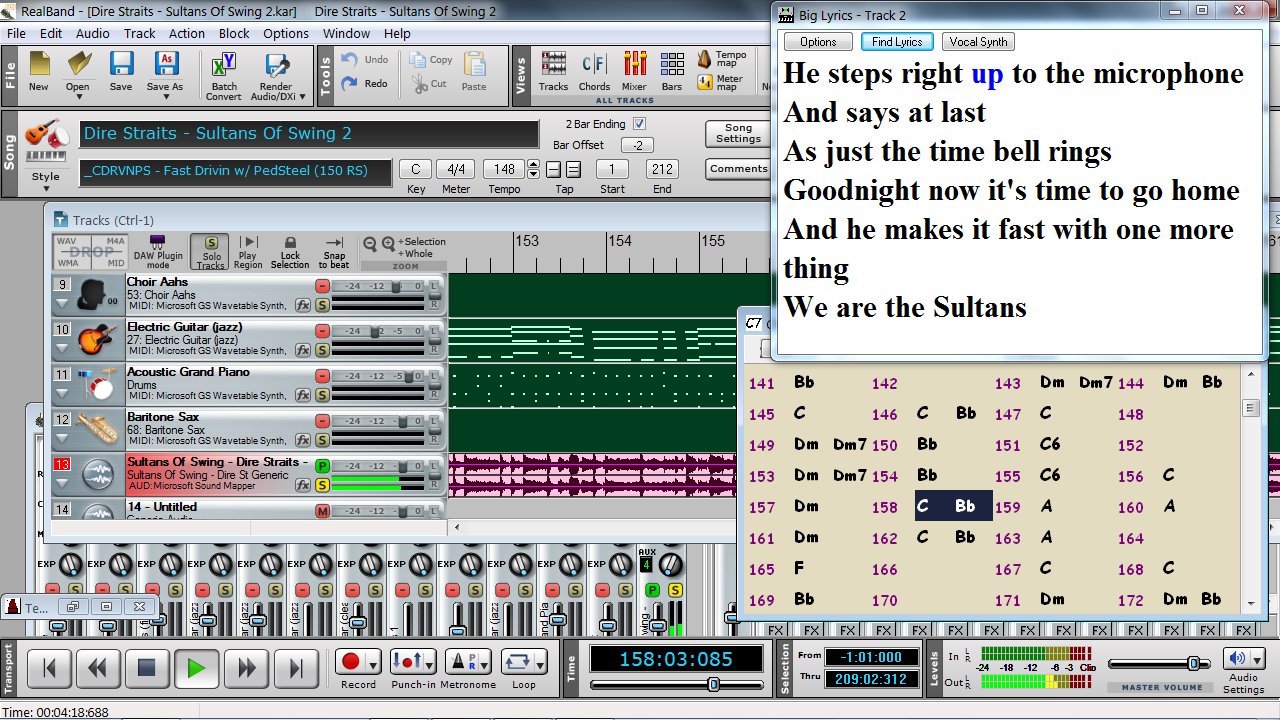
Open it in Realband, set Bar offset to -2, click on Tempo Map, Clear it set Tempo to 148 (this tempo worked with my mp3, you can add to tempo map or change to sync if out), drag the mp3 in and move (Ctrl+Drag) it after highlighting it (Ctrl+A) to align to bar 1, and solo that track, click up on the big L (Lyrics window) click find lyrics.
Edit: the original wav from my CD was 143 so you can leave it at 143 without removing the tempo map if your mp3 is 143, you can also change the tempo of the Amazom mp3 if it's out by highlighting track > right click > Time Stretch..Selected Audio Track > Old Tempo New Tempo, till it syncs.
Willy, I have found the ACW to be unpredictable when transcribing chords from a CD. It does work with simple songs and it works really well if one instrument is playing but it does have problems with whole bands. This is a problem with programs like ACW and not limited to just ACW.
My method goes like follows: 1-google 'song title chords' (no quotes) and you will find a lot of sites that will give you the lyrics and chords and print them out. 2-input chords into BiaB. As most all songs repeat the chords for verses, chorus, etc copy and paste will save you a lot of time. 3-generate a backing track.
I have found this method much faster then using ACW but YMMV.
I hope this helps.
Life is short so make sure you spend as much time as possible on the Internet arguing with strangers.
64 bit Win 10 Pro, the latest BiaB/RB, Roland Octa-Capture audio interface, a ton of software/hardware
To Noel: thanks, I knew about the - and + but hadn't found the place to allow more bars in the display. So that would help, if not for the following: the font of the lyrics in the lyrics bar stays the same enormous size, and when I change the number of bars on the screen, the lyrics basically get shifted around to cover a larger number of bars. When you print this out, the lyrics remain on the printed page where they were before, but each line now has more bars, and thus the correspondence between bar and lyric is lost. I would call that a bug.
As to point #4, I could understand (but just barely) if ACW would put back all the chords that IT thought should be there, but the two or three times I tried it (but now can't reproduce), it got rid of all chords, and just put an F chord in bar 1. All other 212 bars were blank. Also, you are supposed to be able to keep your edits and yet go back to ACW, according to the docs, and to the dialog that asks you if you want to keep all that. But we'll let this go until it happens again... :-)
As to point #2, setting the key to F where most of it is Dm, I think that's fine. Would be good if it could remember that you changed it, though.
To solidrock: Thanks for the pointer, that sure seems like it would save a lot of work. By the way, it seems that RealBand duplicates a bunch of stuff in BIAB. Is RealBand the start of a rewrite of BIAB? Why have two different programs otherwise? I haven't quite figured out when to use BIAB and when to use RB.
To Mario: you may be right, it takes about as much time to edit the chords produced by ACW as it would take to type them in.
About chorus and verse: I have read the docs and FAQ on that, but still don't understand. What is a chorus in BIAB? How would you describe what the chorus is in Sultans of Swing, for example? As I said before, it seems like ABCBCCCCD to me, where A is the intro (8 bars of essentially Dm) and B is the first what I would call verse, C the second (Sultans doesn't really have what I would call choruses), which is like the first, except it has an added piece, and finally a tagline of four bars that get repeated until the song fades out. Suppose I knew what BIAB means by a chorus, could I do something with it? One is supposed to be able to print out multiple lines of lyrics for each bar of chords, for example, but I don't know how to do it.
I'm sorry about all these questions, but you said you didn't mind newbies... :-)
From the Help section: 'Important Note: We are using the term "chorus" as it is often used in Jazz music. A chorus therefore means "once through the entire form of the song." A typical length of a chorus is 32 bars. A song may have the form AABA where the A sections are verses and the B section is the Bridge. This entire form AABA is considered one chorus.'
Essentially it is the entire song, after the intro (if any), and before the ending tag (if any)
Repeats of the chorus can have different settings, e.g. in the screen capture, the song starts at bar 5 (after a 4 bar intro), plays two choruses from bar 5 to 34, on the last chorus, when it gets to bar 11 it jumps to a tag at bar 35, and ends the song at bar 54.
This is designed to give the most flexibility available.
Hope this clarification helps
Regards
Trevor
BIAB & RB2026 Win.(Audiophile), Windows 10 Pro & Windows 11, Cakewalk Bandlab, Izotope Prod.Bundle, Roland RD-1000, Synthogy Ivory, Session Keys Grand S & Electric R, Kontakt, Focusrite 18i20, KetronSD2, NS40M, Pioneer Active Monitors.
Why have two different programs otherwise? I haven't quite figured out when to use BIAB and when to use RB.
The first thing you should like about using Realband is that it lays the whole song out in one linear piece. None of the 'chorus' stuff that is causing your confusion in BiaB. For me the linear layout just seems to be easier to work with. I admit that is a big reason I prefer RB. From your post it seems you would like this also. Plus the additional tracks to work with .. lots of differences.
I do not work here, but the benefits are still awesome Make your sound your own!
Willy, first I'll welcome you too and nobody dislikes noob's here as long as they're respectful. Funny, I keep fighting the urge to add Free to your name...
Anyway,
Here's the deal, you're starting with the ACW and trying to to work with an existing classic song. The ACW is pretty cool and trust me there is nothing like it on the market that I know of. It works "fairly well". The key to the ACW is the simpler the song the better, the more complex the song the worse because we're dealing with an audio file here not midi.
If you had a midi file of Sultans the program would recognize everything about it from the chords to the melody to the voicings of all the instruments but that's midi. Audio is much more difficult to work with. You're asking a dumb computer to do what even you cannot do, use your ears to transcribe difficult music from a record. Not an easy task unless you're a graduate from a big name music school. When you think of it that way you begin to realize just how amazing the ACW is even with it's flaws.
This is not Biab's primary function just like printing charts or sheet music is not it's primary function either. Biab will do lots of interesting and useful things but still what is it's primary purpose? To make good generic backing tracks for you to play along with. That's what it's name means, Band. In. A. Box. As in you get a full band to practice with. It's not designed to create cover versions of classic songs or any of that. It can be made to do that but it's very tricky and that is for advanced power users, not noob's.
You can use loops, you can record some classic song licks yourself in the audio track, you can import parts of midi files of whatever song, you can edit a Biab generated midi part (but not a Real Track, that's audio vs midi again, remember that) and then freeze the track so it won't change when you regenerate the song. All of that is tricky and takes time.
Meanwhile the program is designed for you to simply pick a style and tempo, enter some chords, hit play and start jammin. That's what the program was built for. All the rest of it is icing for experienced users.
My suggestion is learn the basics first, get a handle on how the program works then start with the advanced stuff.
Well, yes, I agree BIAB is mostly to have something to practice with and to make backing tracks.
But in principle, it has these other useful features. Printing out fake sheets is something I'd really like to do, so I can share them with the rest of our after-hours band at work. And making some sheets with the lyrics and where they are in the song would also be really nice. So that's why I tried to do exactly those things first (in addition to using it for practice).
Anyway, the main thing, providing a band to practice with and to make backing tracks BIAB handles quite excellently, I haven't seen any other software that does that as well. But I must say I am having a bit of trouble with just about everything else I've tried so far.
Last Chance! The Band-in-a-Box® 2026 for Mac® Special Ends Today (May 31, 2026) at 11:59pm PDT!
Time really is running out! Save up to 50% on Band-in-a-Box® 2026 for Mac® upgrades and receive a FREE Bonus PAK—only when you order by 11:59 PM PDT today!
We've added many major new features and new content in a redesigned Band-in-a-Box® 2026 for Mac®!
Version 2026 introduces a modernized GUI redesign across the program, with updated toolbars, refreshed windows, smoother workflows, and a new Dark Mode option. There’s also a new side toolbar for quicker access to commonly used windows, and the new Multi-View feature lets you arrange multiple windows as layered panels without overlap, making it easier to customize your workspace.
Another exciting new addition is the amazing new AI-Notes feature, which can transcribe polyphonic audio into MIDI. View the results in notation or play them back as MIDI, and choose whether to transcribe an entire track or transcribe specific parts like drums, bass, guitars/piano, or vocals. There's over 100 new features in Band-in-a-Box® 2026 for Mac®.
There's an amazing collection of new content too, including 202 RealTracks, new RealStyles, MIDI SuperTracks, Instrumental Studies, “Songs with Vocals” Artist Performance Sets, Playable RealTracks Set 5, two RealDrums Stems sets, and much more!
Upgrade your Band-in-a-Box for Mac® to save up to 50% on most Band-in-a-Box® 2026 upgrade packages!
Plus, when you order your Band-in-a-Box® 2026 Mac upgrade during our special, you'll receive a Free Bonus PAK of exciting new add-ons.
If you need any help deciding which package is the best option for you, just let us know. We are here to help!
Band-in-a-Box® 2026 Mac Special Offers Extended Until May 31st!
Good news- we've extended our Band-in-a-Box® 2026 for Mac® special offers until May 31, 2026!
Band-in-a-Box® 2026 is packed with major new features, enhancements, and an incredible lineup of new content! The program now sports a sleek, modern GUI redesign across the entire interface, including updated toolbars, refreshed windows, smoother workflows, a new dark mode option, and more. The brand-new side toolbar provides quicker access to key windows, while the new Multi-View feature lets you arrange multiple windows as layered panels without overlap, creating a flexible, clutter-free workspace. We have an amazing new “AI-Notes” feature. This transcribes polyphonic audio into MIDI so you can view it in notation or play it back as MIDI. You can transcribe an entire track (all pitched instruments and drums) or focus on individual parts like drums, bass, guitars/piano, or vocals. There's an amazing collection of new content too, including 202 RealTracks, new RealStyles, MIDI SuperTracks, Instrumental Studies, “Songs with Vocals” Artist Performance Sets, Playable RealTracks Set 5, two RealDrums Stems sets, and much more!
There are over 100 new features in Band-in-a-Box® 2026 for Mac®.
When you order purchase Band-in-a-Box® 2026 before 11:59 PM PDT on May 31st, you'll also receive a Free Bonus PAK packed with exciting new add-ons.
Check out the Band-in-a-Box® for Mac packages page to find the best package for you.
Today's the Last Day of the Band-in-a-Box 2026® for Mac Special!
Order before 11:59pm PDT today (May 15, 2026) to save up to 50% off your Band-in-a-Box® 2026 for Mac® upgrade and receive a FREE Bonus PAK loaded with great new Add-ons to use with this new version!
Band-in-a-Box® 2026 for Mac - Special Offers End at 11:59pm PDT on Friday, May 15th, 2026!
Order before 11:59pm PDT on Friday, May 15th and SAVE up to 50% on most Band-in-a-Box® version 2026 for Mac Upgrade packages... and that's not all! With your version 2026 for Mac purchase, we'll include a Bonus PAK full of great new Add-ons FREE! Upgrade to the 2026 49-PAK to receive even more NEW Add-ons including 20 additional RealTracks... that's 222 NEW RealTracks available with version Band-in-a-Box® 2026 for Mac!
Upgrade to Band-in-a-Box® 2026 for Mac® today for as little as $49! Check out the Band-in-a-Box® packages page for all available purchase options.
Learn more about the Free Bonus PAK and 49-PAK here.
If you have any questions about which package is the best option for you, just let us know. We're here to help!
202 New RealTracks Released with Band-in-a-Box 2026!
With Band-in-a-Box® 2026, we've released 202 incredible new RealTracks (in sets 468-488) in a variety of genres—featuring your most requested styles!
Jazz, Funk & World (Sets 468-475):
Our new jazz, funk & blues RealTracks include a groovin’ collection of RealTracks and RealDrums! These include more requested “soul jazz” RealTracks featuring artists Neil Swainson (bass), Charles Treadway (organ), Brent Mason (guitar), and Wes Little (drums). There are new “smooth jazz” styles (4), which include a RealTracks first: muted trumpet, as well as slick new smooth jazz brushes options for drums. Blues lovers will be thrilled—there are more “classic acoustic blues” styles, including guitar (5), bass (4), and drums (10) with blues master Colin Linden, featuring understated and tasty background acoustic soloing, plus brushes drums and acoustic bass. There are also new electric blues RealTracks, including electric blues with PG favorite Johnny Hiland (3) and soulful electric slide guitar from Colin Linden (4). If you love funk & gospel, there are great new options this year, including gospel organ (3) from Charles Treadway, as well as new funk, tango, and rock ’n’ roll drums (3) and bass (1). And for big, bold arrangements, we have uptempo soul horns (4) featuring a three-part hip horn section with options for a full mix or stems of each individual horn — plus an accompanying rhythm section (4) of drums, bass, guitar, and electric piano!
Rock & Pop (Sets 476–482):
Our new rock & pop RealTracks bring a powerful mix of requested favorites, fresh genres, and modern chart-inspired styles! We have more of our popular “Producer Layered Acoustic Guitars (15)” featuring Band-in-a-Box favorite Brent Mason. We’ve continued our much-requested disco styles (10), and added new Celtic guitar (5) with a more basic, accessible approach than our previous Drop-D or DADGAD offerings. There are also highly requested yacht rock styles (17), inspired by the smooth, polished soft-rock sound of the late ’70s and early ’80s — laid-back grooves, silky electric pianos, warm textures, elegant harmonic movement, and pristine production aesthetics. Fans of heavier styles will love our new glam metal (13), capturing the flashy, high-energy sound of ’80s arena-ready guitar rock. We also have a set of rootsy modern-folk rock (18), with a warm, organic sound combining contemporary folk textures and driving acoustic strumming. And we’ve added lots of new modern pop styles (16) — the kinds of sounds you’re hearing on the radio today, featuring exciting new drums, synths, and cutting-edge RealTracks arrangements.
Country, & Americana (Sets 483–488):
Our new country & Americana RealTracks deliver a rich collection of acoustic, electric, and roots-inspired styles! We have new country pop (9) with legendary guitarist Brent Mason. There is also a potpourri (14) of bouzouki, guitars, banjo, and more, perfect for adding texture and character to contemporary acoustic arrangements. We’ve added funky country guitar (5) with PG favorite Brent Mason, along with classic pedal steel styles (5) featuring steel great Doug Jernigan. There are more country songwriter styles (8) that provide intimate, rootsy foundations for storytelling and modern Americana writing. Finally, we have “background soloing” acoustic guitar (12) with Brent Mason — simpler, but still very tasty acoustic lines designed to sit beautifully behind vocals or act as a subtle standalone solo part.
And, if you are looking for more, the 2026 49-PAK (for $49) includes an impressive collection of 20 bonus RealTracks, featuring exciting and inspiring additions to add to your RealTracks library. You'll get new country-rhythm guitar styles from PG Music favorites Johnny Hiland and Brent Mason, along with modern-pop grooves that capture today’s radio-ready sound! There are also new indie-folk styles with guitar, bass, 6-string bass used as a high-chording instrument, acoustic guitar, and banjo. Plus, dedicated "cymbal fills" RealDrums provide an added layer that work very well with low-key folky styles with other percussion.
The 2026 49-PAK is loaded with other great new add-ons as well. Learn more about the 2026 49-PAK!
2026 Free Bonus PAK & 49-PAK for Band-in-a-Box® 2026 for Mac®!
With your version 2026 for Mac Pro, MegaPAK, UltraPAK, UltraPAK+, Audiophile Edition or PlusPAK purchase, we'll include a Bonus PAK full of great new Add-ons for FREE! Or upgrade to the 2026 49-PAK for only $49 to receive even more NEW Add-ons including 20 additional RealTracks!
These PAKs are loaded with additional add-ons to supercharge your Band-in-a-Box®!
This Free Bonus PAK includes:
The 2026 RealCombos Booster PAK:
-For Pro customers, this includes 27 new RealTracks and 23 new RealStyles.
-For MegaPAK customers, this includes 25 new RealTracks and 23 new RealStyles.
-For UltraPAK customers, this includes 12 new RealStyles.
MIDI Styles Set 92: Look Ma! More MIDI 15: Latin Jazz
MIDI SuperTracks Set 46: Piano & Organ
Instrumental Studies Set 24: Groovin' Blues Soloing
Artist Performance Set 19: Songs with Vocals 9
Playable RealTracks Set 5
RealDrums Stems Set 9: Cool Brushes
SynthMaster Sounds Set 1 (with audio demos)
iOS Android Band-in-a-Box® App
Looking for more great add-ons, then upgrade to the 2026 49-PAK for just $49 and you'll get:
20 Bonus Unreleased RealTracks and RealDrums with 20 RealStyle.
FLAC Files (lossless audio files) for the 20 Bonus Unreleased RealTracks and RealDrums
MIDI Styles Set 93: Look Ma! More MIDI 16: SynthMaster
MIDI SuperTracks Set 47: More SynthMaster
Instrumental Studies 25 - Soul Jazz Guitar Soloing
Artist Performance Set 20: Songs with Vocals 10
RealDrums Stems Set 10: Groovin' Sticks
SynthMaster Sounds & Styles Set 2 (sounds & styles with audio demos)
One of our representatives will be happy to help you over the phone. Our hours of operation are from
6:00AM to 6:00PM PST (GMT -8) Monday thru Friday, and 8:00AM to 4:00PM PST Saturday. We are closed Sunday. You can also send us your questions via email.
One of our representatives will be happy to help you on our Live Chat or by email. Our hours of operation are from
6:00AM to 6:00PM PST (GMT -8) Monday thru Friday; 8:00AM to 4:00PM PST (GMT -8) Saturday; Closed Sunday.












 Dansk
Dansk Deutsch - Windows
 Español
 Français - Windows
 Italiano - Windows
 Nederlands
 Polski
 Português
 Svenskt
 русский
 Japanese
 Simplified Chinese
 Traditional Chinese
 Korean