Hey, for everyone talking about the benefits of mastering to "industry standards," here's an interesting experiment.
Use the Audacity Program to open up an MP3 of the song "Born to Run"* (if you have one) from the CD and study it. Look at the headroom and listen to the volume level. Look at how the waveform looks like--well, a wave. It rises and falls. It ebbs and flows.
Then do the same thing with "Radio Nowhere"* (for comparison, if you have one.) Look at at how the waveform in Radio Nowhere is a thick blue brick pushed all the way to the edge of maximizing, and then shaved off a few nanometers from spiking with the barest amount of limiting. Notice how the needle is constantly in the red. Notice how your ears bleed. Notice how if you go back to listening to Born to Run after listening to Radio Nowhere you will no longer be able to hear it because it sounds muted and you feel deaf. Those are not your headphones that have been muted. Those are your eardrums.
Ok, now think about this: Born to Run is universally recognized as one of the greatest Rock 'n Roll songs of all time. It took 6 months to produce and about another 6 months to master.
Was the mastering "bad"? Did they not know what they were doing? Did it not sound like a hit? Yet, by Spotify and SoundCloud standards it is nowhere near professional loudness norms.
Are you still sure you want a robot mastering tool mastering your stuff?
Really sure?
Really, really, really sure???
* If you don't have these songs try similar experiments with any songs released say 10 years ago, with any hit released today.
David Snyder Songwriter/Renaissance Man Studio + Fingers
Well I can only agree with the conclusion not being able to listen to either of those songs both absent from my limited CD collection.
I will add one thing technology has come a long way since some songs were released. I believe if any producer would go back and REMASTER any old song, they will end up quite different. But, your point will still be made, today the louder songs would be lowered a bit and the lower volume songs would be raised a bit. We all get Vanilla from the music industry today. No more 31 flavors.
Except here in the PG Forum where we can do anything we Da _ _ _ d well please.
A little more Cowbell!!
Last edited by dga; 05/30/1601:23 PM.
"When you help somebody else you are really helping yourself"
If you don't have these songs try similar experiments with any songs released say 10 years ago, with any hit released today.
Your point is valid but unless you have a DeLorean to go back and release your music before the start of The Loudness War, in order to have any chance of success at all in today's market you must master your stuff using similar techniques as "any hit released today"! On the other hand, if you (like I) have already concluded that you have a better chance of being hit by space debris than getting a hit with your music, then by all means buck the trend, be true to your school, produce the music you like fer sure!
Also wasn't Born to Run released before the days of CD's?? At least back then I had it on vinyl, don't recall if CD players were around then, if they were I didn't own one.
Point is there are many things mastering wise you can do to a track that is destined for digital release, either CD or WAV or MP3, that you couldn't do for a vinyl release, too loud or too much bass and the needle would jump right out of the groove.
I use Ozone (a very old version) to master here, and I'm always very careful to not add too much compression. I tend to go with the less is more approach, mostly because I'm no expert when it comes to this stuff!
Even though Born to run was pre-CD, they still had compressors and limiters. And if they had them , they could use them or abuse them.
The engineers doing much of the mastering and final production in the 70's simply chose to make the music sound good..... not so much loud.... but good. Nice dynamic range, which I recalled reading, was the holy grail in the day. Listeners had volume knobs to make it loud if they wanted.
Now days, everyone seems to want to have the loudest stuff.... because we do know that loud sounds better than "not loud". In a radio line up, if you want your song to stand out a bit... crank up the loudness levels with compression and use a limiter to really squash it into a brick.
The problem is, when everything is the same volume, your ears quickly become fatigued as David pointed out.
To the folks who use Ozone.... you have to be very careful with the compression. As you crank it up, yep, it sounds fatter and better...... but, dynamics are quickly going out the window.
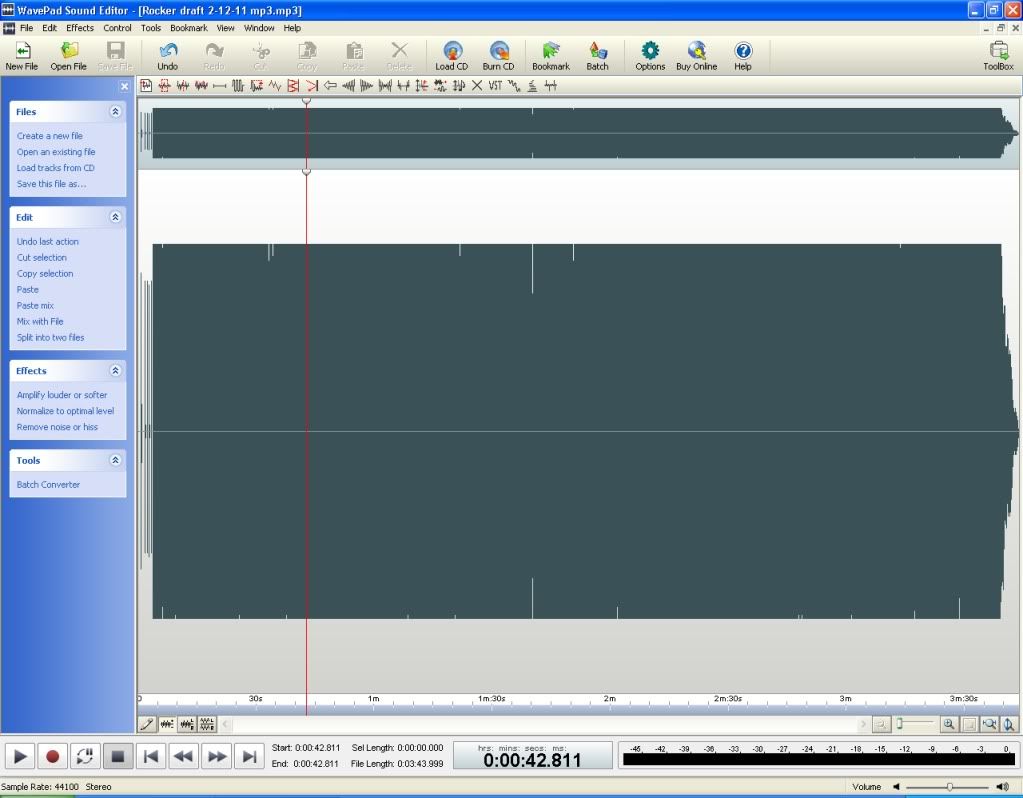
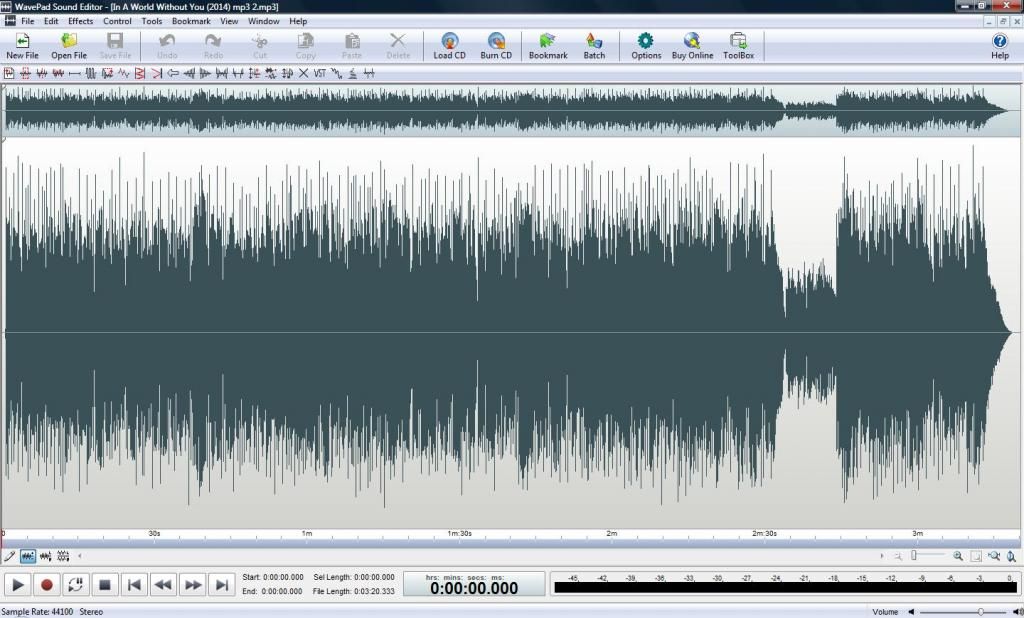
Here's a few waves from my studio and from a few different projects.
This first one was seriously jacked on the compression. I intentionally cranked the levels to get this brick.
So much better..... still a consistent level but not slammed and not down in the valley.
I couldn't find the other wave photo I wanted to post... but the entire point is this.
It is totally possible to get a loud mix and NOT end up with a brick.
I always look at the wave I export in my wave editor and if I think it's got too many overs or flat tops, I will go back to the project and turn down the overall compression level. It needs to have dynamics. The can be lots of mountain peaks but there also needs to be as many valleys and middle ground.
You can find my music at: www.herbhartley.com Add nothing that adds nothing to the music. You can make excuses or you can make progress but not both.
The magic you are looking for is in the work you are avoiding.
One thing I never really see said about "today's music" in these "older is better" arguments is that they also do a lot more sonically to fill in gaps now.
I know, as an example, Nickelback uses a lot of different instruments in their songs that you wouldn't necessarily guess are there...they look for something musical that can cover a spectrum that the other instruments they use don't.
Also, it's not like the guitar is always on 11 AND the drums are on 11. It's more like the guitar is on 11 at some points, then the drums may be at 11 for a fill...but they are usually more like a 7, with the vocal being on 11.
So, yes the entire mix is louder, however there are still internal dynamics that occur.
Why people never talk about THIS part of it more I don't know. Many times I think the argument is misrepresented with statements others have heard over and over and present it as true knowledge.
Myself, I like both, and think they each have their places. You can EASILY find artists today who display dynamics in their music! I guess it's what you are looking for.
When someone says to me "Man, McDonalds...hamburgers just aren't what they used to be!" I ask them "Why are you eating at McDonalds?"
For dynamics, I don't prefer MP3, CD, tape, or vinyl. Give me a LIVE orchestra, and I will show you dynamics! Chills!
Great thread! Thanks for bringing it up. And Bruce Springsteen has GREAT production!
Chad (Hope that makes it easier)
TEMPO TANTRUM: What a lead singer has when they can't stay in time.
Thanks for your comments too!. I agree with the part about filling in spaces, but I suppose I was speaking of the "brick" Herb referred to which is what you will see if you open up a lot of stuff and look at it.
It is totally maxed out. A solid wall of blue. Whatever you put in there to be heard that is "extra" can't be heard because there are no gaps. A brick is a brick is a brick.
I guess that was my point, but I agree with your assessment of the live orchestra.
David Snyder Songwriter/Renaissance Man Studio + Fingers
Thanks for your comments too!. I agree with the part about filling in spaces, but I suppose I was speaking of the "brick" Herb referred to which is what you will see if you open up a lot of stuff and look at it.
It is totally maxed out. A solid wall of blue. Whatever you put in there to be heard that is "extra" can't be heard because there are no gaps. A brick is a brick is a brick.
Yup, I know what you mean. I just meant you can't turn something up that isn't there Louder silence isn't all that loud Sonically they fill every gap then brick it! They point isn't to hear it. That's not my opinion btw. I like things to breath a bit
Quote:
I guess that was my point, but I agree with your assessment of the live orchestra.
It is one of the wonders I wish for everyone to experience.
I have to say, I REALLY enjoyed many of Elton John's songs from Australia with the orchestra. "Tonight" was a completely different song! I love the dynamics of volume and pacing. Enjoy if you are so inclined
Thanks again for the topic!
Chad (Hope that makes it easier)
TEMPO TANTRUM: What a lead singer has when they can't stay in time.
I just downloaded this free product and used it, stand alone and VST. It is amazing!!! It gives you what Ozone does not, even though I love Ozone. What a miracle tool. Thanks you so much for recommending. I will use this all the time. Now you're talking!!!!!!! And it gives you a print out! Dang!!
Love it!!!!
David Snyder Songwriter/Renaissance Man Studio + Fingers
I just downloaded this free product and used it, stand alone and VST. It is amazing!!! It gives you what Ozone does not, even though I love Ozone. What a miracle tool. Thanks you so much for recommending. I will use this all the time. Now you're talking!!!!!!! And it gives you a print out! Dang!!
Love it!!!!
What I usually do is a rough mix, then run it through the TT, making note of the headroom on the L/R channels. Then I "master" the mix and re-check it. If I can maintain the headroom in the mastered mix I had in the rough, I'm a happy camper.
You will love this tool!! You can use it to study some of your favorite MP3s and you can tell at a glance while they sound so great...it shows you the dynamic contrast range as a number. Like 11 is good, 2 is bad. Thick as a brick is like 1.5
Follow the instructions in the manual exactly when loading the file with the DLL in Steinberg. You have to load the whole folder. It will show you. But if you don't do exactly what they say it won't work. Read that manual carefully.
Insert it into the mastering channel of RB or your other DAW and you will never look at your mix strip and effects chains the same way ever again.
It is awesome.
David Snyder Songwriter/Renaissance Man Studio + Fingers
It was in 1970, at The Electric Factory in Philly. He was touring with a bass player and a drummer. Came out alone, sat down and played “Your Song”. It was brilliant. Absolutely brilliant. A moment I've never forgotten.
Then the show became a bit more “flamboyant”. A bit too flamboyant for Philly in 1970.
It was in 1970, at The Electric Factory in Philly. He was touring with a bass player and a drummer. Came out alone, sat down and played “Your Song”. It was brilliant. Absolutely brilliant. A moment I've never forgotten.
Then the show became a bit more “flamboyant”. A bit too flamboyant for Philly in 1970.
Things were very different then.
Regards,
Bob
I was living in South Jersey at that time. We could see the buildings of Camden and Philly from one of my buddies back yard. David Bowie also play The Scene in Philly a lot. I never saw either Bowie or John back in those early days. I did manage to see quite a few big name bands at the Spectrum. Some real icons back before they became icons in the biz. Bob Segar as an opening act... Foghat with one hit song.....ZZ Top before the beards..... Wishbone Ash in Camden in a renovated movie theater.....
What a great time. Yes, things were quite different back then.
Last edited by Guitarhacker; 06/04/1604:38 AM.
You can find my music at: www.herbhartley.com Add nothing that adds nothing to the music. You can make excuses or you can make progress but not both.
The magic you are looking for is in the work you are avoiding.
Philly had a great music scene back then. I saw Sonny Terry and Brownie McGhee at the 2nd Fret and The Velvets numerous times. Everyone who was touring came through Philly.
I was hangin' out at 8th Street Music one day with a pal, and these hairy hippy guys walked in and started shopping. My buddy is freaking out, and I can't understand why.
"Don't you know who that is? he asked me.
"Nope."
"That's the Grateful Dead, man!"
I had no idea who they were. They couldn't find everything they needed for their show that night, so my friend Cliff and I rode around Philly in the back of their rental truck showing them where all the music stores were. They were very nice guys.
Philly had a great music scene back then. I saw Sonny Terry and Brownie McGhee at the 2nd Fret and The Velvets numerous times. Everyone who was touring came through Philly.
I was hangin' out at 8th Street Music one day with a pal, and these hairy hippy guys walked in and started shopping. My buddy is freaking out, and I can't understand why.
"Don't you know who that is? he asked me.
"Nope."
"That's the Grateful Dead, man!"
I had no idea who they were. They couldn't find everything they needed for their show that night, so my friend Cliff and I rode around Philly in the back of their rental truck showing them where all the music stores were. They were very nice guys.
Regards,
Bob
What a cool story! I never got into their music, but they always came across as kind souls.
When I first heard "Radio Nowhere" on the "Magic" CD, I noticed the extreme compression, and at first I didn't like it, especially since the rest of the cd didn't sound like that.
But later I realised that the compression may have been an artistc nod to the over compressed sound of AM radio.
It seems that The Loudness wars are being discussed more than anything. With the drive for maximum volume has come the collateral damage of minimum dynamics. Compression, Limiting, Brick Wall Limiting and Normalizing can all achieve increased loudness in many circumstances. There are restrictions and inherent problems with each. Normalising, for example, can only take the loudest points in a track to the selected maximum volume the range of volume between the loudest and quietest parts is preserved - the dynamics are retained. If you've mixed a track with an aberrant, super loud cymbal hit in one spot the amount of volume or level increase will be minimal if any at all. Compression, (my 1st experience was with TV ads where everything is as loud as everything else), reduces peaks that will then allow the general volume to be "normalized" in relation to those reduced volume peaks. Compression with "catch up" or "make up" gain will reduce the peaks, (by a ratio as set my the user and with a bundle of other variables as well), and automatically lift everything else up toward those new peaks. One of the biggest issues regarding the use of these soft or hardware items are "pumping" where the effect is obvious and the response of the unit/program can be heard starting and ending on the caught peaks. "Colourization" is when the process alters the sound by more than its expected effect due to errors or planning in design and manufacturing(EQ, phase etc). Often we perceive these colourations as advantageous which is why so many old analogue units are being replicated in the digital world. LOUDER is a competitive thing that became a fad and is now, thankfully, receiving a backlash. Will my track sound loud enough beside the previous track on the radio? Well, my songs won't get played there so, from that point of view the issue is moot. The fact that people don't like to adjust the volume control on the phone/MP3 Player/I pod/DAP has a lot to do with it too. Take a track and run it through a sonic maximiser or Aural Enhancer. 1st listen will probably be impressive but, like LOUDness war tracks, repeated or sustain listening will probably render the listener and her/his ear fatigued. Sometimes, when used subtly, the effect is wonderful and not deleterious to the song and listening experience. Mastering? I've experimented with Ozone & the ilk - even LANDR (they offer a free MP3 jobbie and I wanted to do a Mix - LANDR Master- ME master comparison for the sake of thoroughness). The LANDR job was unsympathetic and what I expected for an algorithm based, (upload, select genre, run, listen to result, select variation on that result, give up) attempt. Managing dynamics, by whatever means, requires subtlety and, most crucially, GOOD EARS. I don't have much of the former and almost nothing of the latter so I get a mix as good as I can, (with reference to ears here and other forums), then send it to an M.E. who's work I've sussed out, done before & after comparisons etc. I currently use 2 M.E.s, (more correctly production master engineers), because one does a certain type of my stuff in a way I prefer and the other covers different stuff appropriately.
Cheers rayc "What's so funny about peace, love & understanding?" - N.Lowe
One of the most exciting songs I've heard was listening to Florence and the Machine play Dog Days are Over, live in the studio at the Colbert Show. I was in the audience. The dynamics between Florence's soft singing and the cataclysm of the band coming in was awesome. You can't have dynamics like that if everything is the same volume. These days, I try to arrange and master my songs so they look like the Born to Run wave.
PowerTracks 2026 is here—bringing powerful new enhancements designed to make your production workflow faster, smoother, and more intuitive than ever.
The enhanced Mixer now shows Track Type and Instrument icons for instant track recognition, while a new grid option simplifies editing views. Non-floating windows adopt a modern title bar style, replacing the legacy blue bar.
The Master Volume is now applied at the end of the audio chain for consistent levels and full-signal master effects.
Tablature now includes a “Save bends when saving XML” option for improved compatibility with PG Music tools. Plus, you can instantly match all track heights with a simple Ctrl-release after resizing, and Add2 chords from MGU/SGU files are now fully supported... and more!
Get started today—first-time packages start at just $49.
Already using PowerTracks Pro Audio? Upgrade for as little as $29 and enjoy the latest improvements!
Band-in-a-Box 2026 for Windows Special Offers End Tomorrow (January 15th, 2026) at 11:59 PM PST!
Time really is running out! Save up to 50% on Band-in-a-Box® 2026 for Windows® upgrades and receive a FREE Bonus PAK—only when you order by 11:59 PM PST on Thursday, January 15, 2026!
We've added many major new features and new content in a redesigned Band-in-a-Box® 2026 for Windows®!
Version 2026 introduces a modernized GUI redesign across the program, with updated toolbars, refreshed windows, smoother workflows, and a new Dark Mode option. There’s also a new side toolbar for quicker access to commonly used windows, and the new Multi-View feature lets you arrange multiple windows as layered panels without overlap, making it easier to customize your workspace.
Another exciting new addition is the new AI-Notes feature, which can transcribe polyphonic audio into MIDI. You can view the results in notation or play them back as MIDI, and choose whether to process an entire track or focus on specific parts like drums, bass, guitars/piano, or vocals. There's over 100 new features in Band-in-a-Box® 2026 for Windows®.
There's an amazing collection of new content too, including 202 RealTracks, new RealStyles, MIDI SuperTracks, Instrumental Studies, “Songs with Vocals” Artist Performance Sets, Playable RealTracks Set 5, two RealDrums Stems sets, XPro Styles PAK 10, Xtra Styles PAK 21, and much more!
Upgrade your Band-in-a-Box for Windows to save up to 50% on most Band-in-a-Box® 2026 upgrade packages!
Plus, when you order your Band-in-a-Box® 2026 upgrade during our special, you'll receive a Free Bonus PAK of exciting new add-ons.
If you need any help deciding which package is the best option for you, just let us know. We are here to help!
Band-in-a-Box® 2026 for Windows® Special Offers Extended Until January 15, 2026!
Good news! You still have time to upgrade to the latest version of Band-in-a-Box® for Windows® and save. Our Band-in-a-Box® 2026 for Windows® special now runs through January 15, 2025!
We've packed Band-in-a-Box® 2026 with major new features, enhancements, and an incredible lineup of new content! The program now sports a sleek, modern GUI redesign across the entire interface, including updated toolbars, refreshed windows, smoother workflows, a new dark mode option, and more. The brand-new side toolbar provides quicker access to key windows, while the new Multi-View feature lets you arrange multiple windows as layered panels without overlap, creating a flexible, clutter-free workspace. We have an amazing new “AI-Notes” feature. This transcribes polyphonic audio into MIDI so you can view it in notation or play it back as MIDI. You can process an entire track (all pitched instruments and drums) or focus on individual parts like drums, bass, guitars/piano, or vocals. There's an amazing collection of new content too, including 202 RealTracks, new RealStyles, MIDI SuperTracks, Instrumental Studies, “Songs with Vocals” Artist Performance Sets, Playable RealTracks Set 5, two RealDrums Stems sets, XPro Styles PAK 10, Xtra Styles PAK 21, and much more!
There are over 100 new features in Band-in-a-Box® 2026 for Windows®.
When you order purchase Band-in-a-Box® 2026 before 11:59 PM PST on January 15th, you'll also receive a Free Bonus PAK packed with exciting new add-ons.
Upgrade to Band-in-a-Box® 2026 for Windows® today! Check out the Band-in-a-Box® packages page for all the purchase options available.
Band-in-a-Box 2026 Video: The Newly Designed Piano Roll Window
In this video, we explore the updated Piano Roll, complete with a modernized look and exciting new features. You’ll see new filtering options that make it easy to focus on specific note groups, smoother and more intuitive note entry and editing, and enhanced options for zooming, looping, and more.
Band-in-a-Box 2026 Video: AI Stems & Notes - split polyphonic audio into instruments and transcribe
This video demonstrates how to use the new AI-Notes feature together with the AI-Stems splitter, allowing you to select an audio file and have it separated into individual stems while transcribing each one to its own MIDI track. AI-Notes converts polyphonic audio—either full mixes or individual instruments—into MIDI that you can view in notation or play back instantly.
One of our representatives will be happy to help you over the phone. Our hours of operation are from
6:00AM to 6:00PM PST (GMT -8) Monday thru Friday, and 8:00AM to 4:00PM PST Saturday. We are closed Sunday. You can also send us your questions via email.
One of our representatives will be happy to help you on our Live Chat or by email. Our hours of operation are from
6:00AM to 6:00PM PST (GMT -8) Monday thru Friday; 8:00AM to 4:00PM PST (GMT -8) Saturday; Closed Sunday.










 Louder silence isn't all that loud




 Dansk
Dansk Deutsch - Windows
 Español
 Français - Windows
 Italiano - Windows
 Nederlands
 Polski
 Português
 Svenskt
 русский
 Japanese
 Simplified Chinese
 Traditional Chinese
 Korean