|
Log in to post
|
Print Thread |
|
|
|
|
|
Beginners Forum
|
Joined: Dec 2017
Posts: 146
Apprentice
|
OP

Apprentice
Joined: Dec 2017
Posts: 146 |
1. Is it possible to edit chords in notation view? It says in the manual that it is, but I can't figure it out. 2. I have a song that I imported from an ABC file. How can I move all the notes down by one octave? (keeping in the same key, of course) 3. Can band in the box be used to make something like this? https://www.youtube.com/watch?v=PP1U-z2T0bw&list=PL9VT98VjmJzoSbARWIPxeA5J_h2TbaMpv&index=3Thank you
|
|
|
|
|
|
|
|
|
|
|
|
|
Beginners Forum
|
Joined: Dec 2000
Posts: 12,851
Veteran
|
|
Veteran
Joined: Dec 2000
Posts: 12,851 |
1. I don't believe it is possible to edit the chord symbol (i.e. Gm7b5) in notation view; however, it is possible to change what it looks like (font-wise) and it is possible to edit the actual notes that appear on the notation staff that make up chords. The chord letter will not change by changing the notes, however. You'll need to go back to the chord grid. And any changes made to chords note-wise on anything other than the melody and soloist track will get regenerated unless you freeze the track after making your changes. 2. Assuming your imported ABC file is on either the melody or soloist track, then you just need to transpose down an octave. There are some hot keys to do that: - Ctrl+Alt+1 Transpose Melody down one octave
- Ctrl+Alt+2 Transpose Melody up one octave
- Ctrl+Alt+3 Transpose Soloist down one octave
- Ctrl+Alt+4 Transpose Soloist up one octave
Also, under the "Melody" menu, there is a selection under "Edit Melody Track" to Transpose. Likewise under the "Soloist" menu. 3. And absolutely you can make something like that; however, you will need to have the chord progression do do so (easily obtained in music books or on the web or even interpreted from an imported MIDI file). BIAB, however, will not just take your melody and make a good accompaniment based on the melody (it has an option to try, but it doesn't work very well). Just enter the chords, select an appropriate style from the many available, and you've got your accompaniment from which you can play along on the instrument of your choice.
John Laptop-HP Omen I7 Win11Pro 32GB 12TB SSD Desktop-ASUS-I7 Win10Pro 32GB 12TB SATA BB2026/UMC204HD&404HD/Casios/Cakewalk/Reaper/Studio One/Notion/Dorico/Noteworthy/NI/Halion/IK http://www.sus4chord.com (under rehosting/construction)
|
|
|
|
|
|
|
|
|
|
|
|
|
Beginners Forum
|
Joined: Dec 2017
Posts: 146
Apprentice
|
|
OP
Apprentice
Joined: Dec 2017
Posts: 146 |
Thanks. Your tip about right-clicking *(on the other thread) works great for inserting or deleting bars. I also found that right clicking in notation view gives you an option for adding a chord.
I've got the transposing working now--thanks.
Another question:
After I selected a style for an imported midi file, a message in a yellow box in the lower right corner of the screen popped up. t said something like "100% of the chords are complex, you can improve this by..."
The box disappeared before I could finish reading it, and I don't know how to make it reappear. This program can be quite frustrating!
|
|
|
|
|
|
|
|
|
|
|
|
|
Beginners Forum
|
Joined: Jul 2000
Posts: 27,660
Veteran
|
|
Veteran
Joined: Jul 2000
Posts: 27,660 |
There is a log of these messages. Go to the Help menu, Utilities, Display Log Text File of Yellow/Green Messages
The message was about the Natural Arrangement feature of BIAB, new last year in version 2017. Here's what it says in Help Index, Natural Arrangement (All Songs):
Natural Arrangements (re-interpret complex chords)
If you give a pro musician a complicated chord progression with fancy extensions like C7b9b13 or Gm11, the musician may reinterpret these rather than playing them exactly as written. This can achieve a much better sounding arrangement because the musician has freedom to choose from similar chord extensions. You can get Band-in-a-Box to do the same thing with this option for all tracks in all songs. (Note: To set this feature for all tracks in the current song, use the option in the Song Settings dialog. To set this for specific track(s) in the current song, right-click on the track radio button, go to Track Settings | Set Natural Arrangement, and select an option.)
BIAB 2026 Win Audiophile. Software: Fender Studio One 8, Swam horns, Acoustica-7, Notion 6, Song Master Pro, Win 11 Home. Hardware: Intel i9, 32 Gb; Fender Quantom HD8 & Faderport 8, Royer 121, Adam Sub8 & Neumann 120 monitors.
|
|
|
|
|
|
|
|
|
|
|
|
|
Beginners Forum
|
Joined: Jul 2000
Posts: 27,660
Veteran
|
|
Veteran
Joined: Jul 2000
Posts: 27,660 |
About your first question, could you cite the page in the manual where it says that, please? I agree with John and perhaps it's an error.
For the second question, there are often different ways to do things in BIAB. In this case, you could also go to Options, Preferences, Channels and change the number in the Melody row, second column, from 0 to -1 to sound down an octave, or to 1 to sound up an octave, without changing the notation.
BIAB 2026 Win Audiophile. Software: Fender Studio One 8, Swam horns, Acoustica-7, Notion 6, Song Master Pro, Win 11 Home. Hardware: Intel i9, 32 Gb; Fender Quantom HD8 & Faderport 8, Royer 121, Adam Sub8 & Neumann 120 monitors.
|
|
|
|
|
|
|
|
|
|
|
|
|
Beginners Forum
|
Joined: Oct 2008
Posts: 20,671
Veteran
|
|
Veteran
Joined: Oct 2008
Posts: 20,671 |
Is it possible to edit chords in notation view? It says in the manual that it is, but I can't figure it out. When I want to change chords in notation view, the two ways that I do it are... 1. right-click the mouse above the staff on the chord (or the space where chords are located) choose "Edit chord" from the right-click menu. 2. left-click on the chord and press CTRL+F2 Regards, Noel
MY SONGS...Audiophile BIAB 2026
|
|
|
|
|
|
|
|
|
|
|
|
|
Beginners Forum
|
Joined: Dec 2017
Posts: 146
Apprentice
|
|
OP
Apprentice
Joined: Dec 2017
Posts: 146 |
About your first question, could you cite the page in the manual where it says that, please? I agree with John and perhaps it's an error.
First paragraph on page 212 of the 2018 pdf manual, under the topic "Standard Notation Window". "The standard notation window can be used for notation display and the entry of chords and lyrics."
|
|
|
|
|
|
|
|
|
|
|
|
|
Beginners Forum
|
Joined: Oct 2008
Posts: 20,671
Veteran
|
|
Veteran
Joined: Oct 2008
Posts: 20,671 |
Is it possible to edit chords in notation view? It says in the manual that it is, but I can't figure it out. When I want to change chords in notation view, the two ways that I do it are... 1. right-click the mouse above the staff on the chord (or the space where chords are located) choose "Edit chord" from the right-click menu. 2. left-click on the chord and press CTRL+F2 Regards, Noel Lesley, Thank you for the additional information about page 212. I wasn't aware that the above two processes that I gave had been modified so that one now only needs locate the beat cursor and type a chord. That's a nice addition to the program! Thanks! To add a little more information for you, in case it's useful... If you want to enter a chord on beats 1 and 2, position the beat cursor between beats 1 and 3 and type the chords separated by a comma. For example.... 1. click on beat 1 of the bar (this will locate the beat cursor) 2. type c,am <enter> 3. this will put C on beat 1 and Am on beat 2. Regards, Noel
MY SONGS...Audiophile BIAB 2026
|
|
|
|
|
|
|
|
|
|
|
|
|
Beginners Forum
|
Joined: Dec 2017
Posts: 146
Apprentice
|
|
OP
Apprentice
Joined: Dec 2017
Posts: 146 |
Lesley, Thank you for the additional information about page 212. I wasn't aware that the above two processes that I gave had been modified so that one now only needs locate the beat cursor and type a chord. That's a nice addition to the program! Thanks! To add a little more information for you, in case it's useful... If you want to enter a chord on beats 1 and 2, position the beat cursor between beats 1 and 3 and type the chords separated by a comma. For example.... 1. click on beat 1 of the bar (this will locate the beat cursor) 2. type c,am <enter> 3. this will put C on beat 1 and Am on beat 2. Regards, Noel Thinks for this. Is the beat cursor the yellow vertical bar? I found I can edit notes in notation view, but not add new ones. Another unrelated question: Often with, say, 4 by 4 timing the first bar has only one beat, and the last bar has only 3 beats. How can I make BIAB do that? And how can I make the last bar look like a last bar (thick and thin lines at the end of a bar). I'm just trying to figure out the program by entering a 16 bar folk song with chords. Quite a learning curve! Most of the styles seem to be for anything but folk or Celtic. I guess I need to buy more styles. But I can't seem to figure out what styles are in each package. It would be nice if they grouped the styles in packages according to genre, so you didn't have to buy a lot of styles you will never use. Edit : "This Road" is lovely. Is the accompaniment a "style" ?
Last edited by Lesley55; 12/15/17 09:24 PM.
|
|
|
|
|
|
|
|
|
|
|
|
|
Beginners Forum
|
Joined: Oct 2008
Posts: 20,671
Veteran
|
|
Veteran
Joined: Oct 2008
Posts: 20,671 |
Thank for this. Is the beat cursor the yellow vertical bar?
I found I can edit notes in notation view, but not add new ones. Yes. The yellow vertical bar is the cursor that progesses with the beats. In relation to adding notation when in Notation View, it's necessary to switch to Editable Notation Mode. This is the option shown on the image below as '2'. 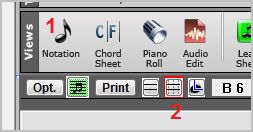 Another unrelated question:
Often with, say, 4 by 4 timing the first bar has only one beat, and the last bar has only 3 beats. How can I make BIAB do that? And how can I make the last bar look like a last bar (thick and thin lines at the end of a bar). The "(first bar) + (last bar) = (whole bar)" scenario is a convenient notational technique. It is not how songs are performed. Rather, it simply summarises the performance and collects repetitive sections into a single 'once through' with repeats. Using the above it's possible to summarise (for example) a 96 bar performance into the repetition of 6 lots of 16 bars. Thus the musician is can play the entire song from a mere 16 bars of notation with repetition. A long time ago, I decided to stop using BIAB from a notation perspective and to use it from a performance perspective. Thus, for me, a song that requires 96 bars would be laid out as a single chorus that's 96 bars long. That way, I have complete control over every aspect of how the the 96 bars are performed. Using copy and paste, it doesn't take too much time to set out a song as a 'once through' performance. Have a look at the below song of mine on Vimeo. It's a video of how the chord sheet progresses as the song plays. This is what I mean by a 'once through' performance. CAN YOU IMAGINEhttps://vimeo.com/143978481Thanks for having a listen to "This Road". I appreciate the comments. I'll go back through my song's creation and see if I used a style (I don't usually). I'll put my thoughts about styles and how I find instruments in a subsequent post in this thread.
MY SONGS...Audiophile BIAB 2026
|
|
|
|
|
|
|
|
|
|
|
|
|
Beginners Forum
|
Joined: Dec 2017
Posts: 146
Apprentice
|
|
OP
Apprentice
Joined: Dec 2017
Posts: 146 |
Terrific song, and arrangement! Were you playing the violin, too?
I don't write songs, or sing or play guitar (I used to play guitar a bit) but I am learning to play the chromatic harmonica, and I want to make accompaniments that show the notes--I particularly like having the current note turn red during play--it just seems so neat to be able to do that. I find that when I go to the "fake sheet" mode and play a song that doesn't fit on one page, the notation doesn't change pages smoothly, but lags, or has part of one page on top of another. So until I can sort that out I'm sticking to songs I can fit on one page of notation.
Thanks so much for your help!
Last edited by Lesley55; 12/16/17 08:06 AM.
|
|
|
|
|
|
|
|
|
|
|
|
|
Beginners Forum
|
Joined: Oct 2008
Posts: 20,671
Veteran
|
|
Veteran
Joined: Oct 2008
Posts: 20,671 |
Hi again, Lesley.
Thanks for your comments on "Can You Imagine".
In relation to "This Road", I did use a style as the starting place for this song. The style was _PJONPBA.STY.
As I started playing around, though, I tried out various Realtracks and Realdrums to get what I eventually ended up with.
RealTracks Picker makes it easy to begin isolating suitable instruments. My process is...
1. Click on the "Tempo" heading column. This sorts the instruments by tempo.
This tempo is what the instruments were recorded at and so it represents the best tempo choice for a song if you want to get the best sound from a Realtrack.
As a general principle, if a Realtrack is used at a tempo that's more than 10 bpm slower or more than 15 bpm faster than its recording tempo, audio artifacts are produced when the Realtrack is generated and these mar the quality of the final sound.
2. Once sorted by tempo, scroll down/up to find the Realtracks that are closest to my song's tempo.
Also.... if the song is an even tempo (say, rock, latin, etc.), look for RTs that have EV present in the "Feel" column in Realtrack Picker. If the song is swing based, look for RTs that have SW in the "Feel" column.
For example...
Since "This Road" is a rock ballad with a tempo of 85 bpm, I looked at the RTs that had a recording tempo of 80 - 90 bpm and that had EV present in the "Feel" column.
3. I use the Band/Solo audition button in the picker window to audition each track. If I find one I like, I then insert it in the song and generate the song to see how it sounds.
Hope these brief thoughts offer some useful information.
Regards,
Noel
P.S. All the instruments in "This Road" were from BIAB. all I played were the choral voices.
MY SONGS...Audiophile BIAB 2026
|
|
|
|
|
|
|
|
|
|
|
|
Ask sales and support questions about Band-in-a-Box using natural language.
ChatPG's knowledge base includes the full Band-in-a-Box User Manual and sales information from the website.
|
|
|
|
|
|
|
|
|
|
|
Peter Gannon Talks Band-in-a-Box with zplane
zplane recently interviewed Peter Gannon, the founder and creator of Band-in-a-Box, about the software's early days, what sets it apart from AI, how zplane's audio algorithms are used in Band-in-a-Box, and more!
Special thanks to the team at zplane for their continued support.
Check out the full interview here: https://products.zplane.de/blog/peter-gannon-interview-pg-music
Last Chance! The Band-in-a-Box® 2026 for Mac® Special Ends Today (May 31, 2026) at 11:59pm PDT!
Time really is running out! Save up to 50% on Band-in-a-Box® 2026 for Mac® upgrades and receive a FREE Bonus PAK—only when you order by 11:59 PM PDT today!
We've added many major new features and new content in a redesigned Band-in-a-Box® 2026 for Mac®!
Version 2026 introduces a modernized GUI redesign across the program, with updated toolbars, refreshed windows, smoother workflows, and a new Dark Mode option. There’s also a new side toolbar for quicker access to commonly used windows, and the new Multi-View feature lets you arrange multiple windows as layered panels without overlap, making it easier to customize your workspace.
Another exciting new addition is the amazing new AI-Notes feature, which can transcribe polyphonic audio into MIDI. View the results in notation or play them back as MIDI, and choose whether to transcribe an entire track or transcribe specific parts like drums, bass, guitars/piano, or vocals. There's over 100 new features in Band-in-a-Box® 2026 for Mac®.
There's an amazing collection of new content too, including 202 RealTracks, new RealStyles, MIDI SuperTracks, Instrumental Studies, “Songs with Vocals” Artist Performance Sets, Playable RealTracks Set 5, two RealDrums Stems sets, and much more!
Upgrade your Band-in-a-Box for Mac® to save up to 50% on most Band-in-a-Box® 2026 upgrade packages!
Plus, when you order your Band-in-a-Box® 2026 Mac upgrade during our special, you'll receive a Free Bonus PAK of exciting new add-ons.
If you need any help deciding which package is the best option for you, just let us know. We are here to help!
Band-in-a-Box® 2026 Mac Special Offers Extended Until May 31st!
Good news- we've extended our Band-in-a-Box® 2026 for Mac® special offers until May 31, 2026!
Band-in-a-Box® 2026 is packed with major new features, enhancements, and an incredible lineup of new content! The program now sports a sleek, modern GUI redesign across the entire interface, including updated toolbars, refreshed windows, smoother workflows, a new dark mode option, and more. The brand-new side toolbar provides quicker access to key windows, while the new Multi-View feature lets you arrange multiple windows as layered panels without overlap, creating a flexible, clutter-free workspace. We have an amazing new “AI-Notes” feature. This transcribes polyphonic audio into MIDI so you can view it in notation or play it back as MIDI. You can transcribe an entire track (all pitched instruments and drums) or focus on individual parts like drums, bass, guitars/piano, or vocals. There's an amazing collection of new content too, including 202 RealTracks, new RealStyles, MIDI SuperTracks, Instrumental Studies, “Songs with Vocals” Artist Performance Sets, Playable RealTracks Set 5, two RealDrums Stems sets, and much more!
There are over 100 new features in Band-in-a-Box® 2026 for Mac®.
When you order purchase Band-in-a-Box® 2026 before 11:59 PM PDT on May 31st, you'll also receive a Free Bonus PAK packed with exciting new add-ons.
Check out the Band-in-a-Box® for Mac packages page to find the best package for you.
Holiday Weekend Hours
It's Victoria Day Long Weekend in Canada. Our Customer Service hours are:
Saturday, May 16: Closed
Sunday, May 17: Closed
Monday, May 18: 8:00am - 4:00pm
Regular hours resume Tuesday, May 19th!
Today's the Last Day of the Band-in-a-Box 2026® for Mac Special!
Order before 11:59pm PDT today (May 15, 2026) to save up to 50% off your Band-in-a-Box® 2026 for Mac® upgrade and receive a FREE Bonus PAK loaded with great new Add-ons to use with this new version!
Don't wait - order today!
Check out all the new features in the redesigned Band-in-a-Box® 2026 for Mac®!
Band-in-a-Box® 2026 for Mac - Special Offers End at 11:59pm PDT on Friday, May 15th, 2026!
Order before 11:59pm PDT on Friday, May 15th and SAVE up to 50% on most Band-in-a-Box® version 2026 for Mac Upgrade packages... and that's not all! With your version 2026 for Mac purchase, we'll include a Bonus PAK full of great new Add-ons FREE! Upgrade to the 2026 49-PAK to receive even more NEW Add-ons including 20 additional RealTracks... that's 222 NEW RealTracks available with version Band-in-a-Box® 2026 for Mac!
Upgrade to Band-in-a-Box® 2026 for Mac® today for as little as $49! Check out the Band-in-a-Box® packages page for all available purchase options.
Learn more about the Free Bonus PAK and 49-PAK here.
If you have any questions about which package is the best option for you, just let us know. We're here to help!
202 New RealTracks Released with Band-in-a-Box 2026!
With Band-in-a-Box® 2026, we've released 202 incredible new RealTracks (in sets 468-488) in a variety of genres—featuring your most requested styles!
Jazz, Funk & World (Sets 468-475):
Our new jazz, funk & blues RealTracks include a groovin’ collection of RealTracks and RealDrums! These include more requested “soul jazz” RealTracks featuring artists Neil Swainson (bass), Charles Treadway (organ), Brent Mason (guitar), and Wes Little (drums). There are new “smooth jazz” styles (4), which include a RealTracks first: muted trumpet, as well as slick new smooth jazz brushes options for drums. Blues lovers will be thrilled—there are more “classic acoustic blues” styles, including guitar (5), bass (4), and drums (10) with blues master Colin Linden, featuring understated and tasty background acoustic soloing, plus brushes drums and acoustic bass. There are also new electric blues RealTracks, including electric blues with PG favorite Johnny Hiland (3) and soulful electric slide guitar from Colin Linden (4). If you love funk & gospel, there are great new options this year, including gospel organ (3) from Charles Treadway, as well as new funk, tango, and rock ’n’ roll drums (3) and bass (1). And for big, bold arrangements, we have uptempo soul horns (4) featuring a three-part hip horn section with options for a full mix or stems of each individual horn — plus an accompanying rhythm section (4) of drums, bass, guitar, and electric piano!
Rock & Pop (Sets 476–482):
Our new rock & pop RealTracks bring a powerful mix of requested favorites, fresh genres, and modern chart-inspired styles! We have more of our popular “Producer Layered Acoustic Guitars (15)” featuring Band-in-a-Box favorite Brent Mason. We’ve continued our much-requested disco styles (10), and added new Celtic guitar (5) with a more basic, accessible approach than our previous Drop-D or DADGAD offerings. There are also highly requested yacht rock styles (17), inspired by the smooth, polished soft-rock sound of the late ’70s and early ’80s — laid-back grooves, silky electric pianos, warm textures, elegant harmonic movement, and pristine production aesthetics. Fans of heavier styles will love our new glam metal (13), capturing the flashy, high-energy sound of ’80s arena-ready guitar rock. We also have a set of rootsy modern-folk rock (18), with a warm, organic sound combining contemporary folk textures and driving acoustic strumming. And we’ve added lots of new modern pop styles (16) — the kinds of sounds you’re hearing on the radio today, featuring exciting new drums, synths, and cutting-edge RealTracks arrangements.
Country, & Americana (Sets 483–488):
Our new country & Americana RealTracks deliver a rich collection of acoustic, electric, and roots-inspired styles! We have new country pop (9) with legendary guitarist Brent Mason. There is also a potpourri (14) of bouzouki, guitars, banjo, and more, perfect for adding texture and character to contemporary acoustic arrangements. We’ve added funky country guitar (5) with PG favorite Brent Mason, along with classic pedal steel styles (5) featuring steel great Doug Jernigan. There are more country songwriter styles (8) that provide intimate, rootsy foundations for storytelling and modern Americana writing. Finally, we have “background soloing” acoustic guitar (12) with Brent Mason — simpler, but still very tasty acoustic lines designed to sit beautifully behind vocals or act as a subtle standalone solo part.
Check out all the 202 new RealTracks (in sets 468-488)!
And, if you are looking for more, the 2026 49-PAK (for $49) includes an impressive collection of 20 bonus RealTracks, featuring exciting and inspiring additions to add to your RealTracks library. You'll get new country-rhythm guitar styles from PG Music favorites Johnny Hiland and Brent Mason, along with modern-pop grooves that capture today’s radio-ready sound! There are also new indie-folk styles with guitar, bass, 6-string bass used as a high-chording instrument, acoustic guitar, and banjo. Plus, dedicated "cymbal fills" RealDrums provide an added layer that work very well with low-key folky styles with other percussion.
The 2026 49-PAK is loaded with other great new add-ons as well. Learn more about the 2026 49-PAK!
|
|
|
|
|
|
|
|
|
|
|
|
Forums57
Topics86,588
Posts807,162
Members40,167
| |
Most Online64,515
Apr 8th, 2026
|
|
|
|
|
|
|
|
|




 Dansk
Dansk Deutsch - Windows
 Español
 Français - Windows
 Italiano - Windows
 Nederlands
 Polski
 Português
 Svenskt
 русский
 Japanese
 Simplified Chinese
 Traditional Chinese
 Korean