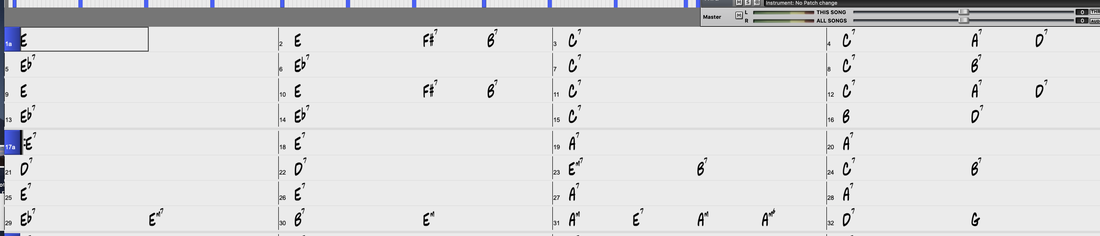
Janice and I come from years of playing 3-6 chord bluegrass, blues and classic country -- a lot of what is now known as Americana. Beyond that we get a bit lost with neither of us knowing any theory. We are working on a PD song published in 1914 called Ballin' The Jack. It introduced a new dance and has been done by everybody from Judy Garland to Dean Martin to Pearl Bailey to Fats Domino to show tune formats. We tried some of the very simple progressions but tend to like the more early jazz versions. Below is a 16 bar verse we found presented as being in G. The chords seemed odd but sound pretty good so I looked at more versions and many of them although in other keys were relatively the same as this.
So I'll show my ignorance (ample precedent) --- aren't the E, Eb and F# chords odd for the key? Thanks for any help and perhaps my ignorance has given you a good laugh!
Our albums and singles are on Spotify, Apple Music, Amazon Music, YouTube Music, Pandora and more. If interested search on Janice Merritt. Thanks! A few of our videos are here on our website: https://www.janiceandbud.com/our-music.html
I had thought it was the wrong key until I found it again with a stated key of G. At which point I assumed I must be missing something But yeah the progression works.
Bud
Our albums and singles are on Spotify, Apple Music, Amazon Music, YouTube Music, Pandora and more. If interested search on Janice Merritt. Thanks! A few of our videos are here on our website: https://www.janiceandbud.com/our-music.html
Can you save us some time and post a BIAB song with this progression?
I don’t want to take up your time. Thought it would be a quick question. Sorry.
Janice
Our albums and singles are on Spotify, Apple Music, Amazon Music, YouTube Music, Pandora and more. If interested search on Janice Merritt. Thanks! A few of our videos are here on our website: https://www.janiceandbud.com/our-music.html
Thank you Matt! We appreciate it. I dropped it into BiaB along with the chorus.
Here it is with the verse and the chorus. The chorus does resolve to a G FWIW.
J&B
Our albums and singles are on Spotify, Apple Music, Amazon Music, YouTube Music, Pandora and more. If interested search on Janice Merritt. Thanks! A few of our videos are here on our website: https://www.janiceandbud.com/our-music.html
One of the basic theoretical shortcuts for helping to analyse music is that when looking for modulations, isolate the 7th chords. If these chords form a V7 to I (e.g. G7 to C) or V7 to VI (e.g. G7 to Am), then the music has been temporarily modulated.
Often such temporary modulations occur so quickly that there is no accompanying (pun not intended but I like it) feeling that a modulation has occurred.
So with the above couple of thoughts in mind, my take on this is...
At the end of this progression we see "D7", if the next chord is "G" then a V7-I progression has occurred and the music in the subsequent section that's not provided is indeed in the key of G major (or G minor if the chord following D7 is Gm -- this is still a I-V progression in a minor key).
Now for the chord progression...
For ease of reference, I'll ignore the 7s and just look at the major/minor chords.
If I consider E as a tonic (i.e. E = chord I), Then the first four chords E-F#-B-C is a I-II-V-bVI progression.
Now if the C chord is a pivot chord and it becomes chord IV in the key of G (i.e C changes from bVI in the key of E to IV in the key of G) , we have the progression C-A-D-Eb expressed as IV-II-V-bVI. A pattern of II-V-bVI now seems to be emerging... let's continue and see what happens
If the C (second line of chords, chord #3) now starts out as IV in the key of G major and changes into into bVI in the key of E major (i.e. it's another pivot chord), we have the chord progession C-B-E-F#-B-C (in the key of E major) as bVI-V-I-II-V-bVI.
So it looks like the above progression revolves around a II-V-bVI progression in the keys of E and G major with chord II being the major chord rather than the usual minor chord that's found on the second degree of the major scale. The C chord seems to be the pivot chord that allows transition between keys.
So below is a picture that I hope summarises my interpretation (the chords with asterisks seem to be pivot chords -- that is they straddle two keys and allow for a change from one key to another)...
Just my thoughts.... I could be totally wrong! Noel
P.S. Here's a pretty good article on using bVI chords in music.
I started down the analytical route Noel took, but decided the composer is being too cute. That's why I keyed the changes into BIAB and lived with it a few minutes. This convinced me it's in E.
BIAB 2026 Win Audiophile. Software: Fender Studio One 8, Swam horns, Acoustica-7, Notion 6, Song Master Pro, Win 11 Home. Hardware: Intel i9, 32 Gb; Fender Quantom HD8 & Faderport 8, Royer 121, Adam Sub8 & Neumann 120 monitors.
Maybe this is a simpleton approach but looking through the chord progression and not seeing a single instance of a G chord, my brain has a hard time believing it’s in G.
The more I think about this, this more I'm of the opinion that this verse sets out not to have an easily identifiable tonal centre so that when the song arrives at the chorus, the sense of 'home base' is amplified and felt strongly.
I found the image below of a version that's written in the key of G major. The chords you give are a minor third lower than the chords on this music. This suggests that your chords are in the 'overall' key of E major.
Notice how the at the bottom right of the below image, there are two flats in the upcoming key signature (this suggests Bb major) and the last chord is F7 (which leads to Bb major as a V-1 progression).
Interestingly if I go down a minor third from F7, I get D7 (the last chord in your above post). Also a minor 3rd down from Bb is G -- also in keeping with your post.
So... using the image below, your chords would seem to be in E major but drifting every now into a slightly hinted key of G.
You might find that you get better results from BIAB if you set the key for the verse to E and the key to the chorus to G. My experience is that such settings help BIAB isolate which chords will work best.
I suspect (maybe wrongly) that the suggestion it is in the key of G is incorrect.
In the diatonic scale, the intervals for an E major chord would land on a G# as the first triad. I like to think that discordance is allowed, but to me this is a little too challenging.
The only chord that comes close to suggest G Major, is the Eb which would have G natural as the first triad and include a D natural as the 7th.
Even the C7 would introduce a Bb, which would lead more to a G minor key.
Regardless, Bud, there are no stupid questions (well not on this forum anyway). Moreover, I think you've already identified that this progression is peculiar for a tune supposed to be in the the of G Major and suspect that it is incorrect.
My definite guess is E Major.
BIAB & RB2026 Win.(Audiophile), Windows 10 Pro & Windows 11, Cakewalk Bandlab, Izotope Prod.Bundle, Roland RD-1000, Synthogy Ivory, Session Keys Grand S & Electric R, Kontakt, Focusrite 18i20, KetronSD2, NS40M, Pioneer Active Monitors.
I very rarely use styles. Having worked with RTs and RDs for years I like to make up a band per each production.
This song will have a rockabilly bass, Nashville Drums, a jazz rhythm guitar, a 40's boogie piano (Midi Super Track ultimately), a fiddle chop rhythm and either a gypsy jazz or a western swing fiddle for the solo. As always Janice will do the vocals.
Here is a very ROUGH representation of how the chords sound with what will become the band. Please note the word "rough" as I have done NO track comping which I nearly always do to remove funky notes, improve segues, enhance fills, etc., and make the tracks more compatible with the vocal.
Our albums and singles are on Spotify, Apple Music, Amazon Music, YouTube Music, Pandora and more. If interested search on Janice Merritt. Thanks! A few of our videos are here on our website: https://www.janiceandbud.com/our-music.html
The thing I have learned about music in all the years I have studied theory, (several years of study on theory) and played my instruments both with and without lessons. My piano teacher was big on explaining the theory behind the music to make it understandable, and I was in a music theory class and that's all we studied, and worked things out with a piano..... It breaks down as follows.
There are essentially TWO rules in music.
1. There are rules in music that must be followed. 2. There are no rules in music and thou canst doth whatever thou wish.
So, no matter what the key and what you expect to hear or to have happen next, it doesn't matter as long as, in the context of how it is used, it sounds good. No chord or progression is off limits if you can make it work.
You can find my music at: www.herbhartley.com Add nothing that adds nothing to the music. You can make excuses or you can make progress but not both.
The magic you are looking for is in the work you are avoiding.
zplane recently interviewed Peter Gannon, the founder and creator of Band-in-a-Box, about the software's early days, what sets it apart from AI, how zplane's audio algorithms are used in Band-in-a-Box, and more!
Special thanks to the team at zplane for their continued support.
Last Chance! The Band-in-a-Box® 2026 for Mac® Special Ends Today (May 31, 2026) at 11:59pm PDT!
Time really is running out! Save up to 50% on Band-in-a-Box® 2026 for Mac® upgrades and receive a FREE Bonus PAK—only when you order by 11:59 PM PDT today!
We've added many major new features and new content in a redesigned Band-in-a-Box® 2026 for Mac®!
Version 2026 introduces a modernized GUI redesign across the program, with updated toolbars, refreshed windows, smoother workflows, and a new Dark Mode option. There’s also a new side toolbar for quicker access to commonly used windows, and the new Multi-View feature lets you arrange multiple windows as layered panels without overlap, making it easier to customize your workspace.
Another exciting new addition is the amazing new AI-Notes feature, which can transcribe polyphonic audio into MIDI. View the results in notation or play them back as MIDI, and choose whether to transcribe an entire track or transcribe specific parts like drums, bass, guitars/piano, or vocals. There's over 100 new features in Band-in-a-Box® 2026 for Mac®.
There's an amazing collection of new content too, including 202 RealTracks, new RealStyles, MIDI SuperTracks, Instrumental Studies, “Songs with Vocals” Artist Performance Sets, Playable RealTracks Set 5, two RealDrums Stems sets, and much more!
Upgrade your Band-in-a-Box for Mac® to save up to 50% on most Band-in-a-Box® 2026 upgrade packages!
Plus, when you order your Band-in-a-Box® 2026 Mac upgrade during our special, you'll receive a Free Bonus PAK of exciting new add-ons.
If you need any help deciding which package is the best option for you, just let us know. We are here to help!
Band-in-a-Box® 2026 Mac Special Offers Extended Until May 31st!
Good news- we've extended our Band-in-a-Box® 2026 for Mac® special offers until May 31, 2026!
Band-in-a-Box® 2026 is packed with major new features, enhancements, and an incredible lineup of new content! The program now sports a sleek, modern GUI redesign across the entire interface, including updated toolbars, refreshed windows, smoother workflows, a new dark mode option, and more. The brand-new side toolbar provides quicker access to key windows, while the new Multi-View feature lets you arrange multiple windows as layered panels without overlap, creating a flexible, clutter-free workspace. We have an amazing new “AI-Notes” feature. This transcribes polyphonic audio into MIDI so you can view it in notation or play it back as MIDI. You can transcribe an entire track (all pitched instruments and drums) or focus on individual parts like drums, bass, guitars/piano, or vocals. There's an amazing collection of new content too, including 202 RealTracks, new RealStyles, MIDI SuperTracks, Instrumental Studies, “Songs with Vocals” Artist Performance Sets, Playable RealTracks Set 5, two RealDrums Stems sets, and much more!
There are over 100 new features in Band-in-a-Box® 2026 for Mac®.
When you order purchase Band-in-a-Box® 2026 before 11:59 PM PDT on May 31st, you'll also receive a Free Bonus PAK packed with exciting new add-ons.
Check out the Band-in-a-Box® for Mac packages page to find the best package for you.
Today's the Last Day of the Band-in-a-Box 2026® for Mac Special!
Order before 11:59pm PDT today (May 15, 2026) to save up to 50% off your Band-in-a-Box® 2026 for Mac® upgrade and receive a FREE Bonus PAK loaded with great new Add-ons to use with this new version!
Band-in-a-Box® 2026 for Mac - Special Offers End at 11:59pm PDT on Friday, May 15th, 2026!
Order before 11:59pm PDT on Friday, May 15th and SAVE up to 50% on most Band-in-a-Box® version 2026 for Mac Upgrade packages... and that's not all! With your version 2026 for Mac purchase, we'll include a Bonus PAK full of great new Add-ons FREE! Upgrade to the 2026 49-PAK to receive even more NEW Add-ons including 20 additional RealTracks... that's 222 NEW RealTracks available with version Band-in-a-Box® 2026 for Mac!
Upgrade to Band-in-a-Box® 2026 for Mac® today for as little as $49! Check out the Band-in-a-Box® packages page for all available purchase options.
Learn more about the Free Bonus PAK and 49-PAK here.
If you have any questions about which package is the best option for you, just let us know. We're here to help!
202 New RealTracks Released with Band-in-a-Box 2026!
With Band-in-a-Box® 2026, we've released 202 incredible new RealTracks (in sets 468-488) in a variety of genres—featuring your most requested styles!
Jazz, Funk & World (Sets 468-475):
Our new jazz, funk & blues RealTracks include a groovin’ collection of RealTracks and RealDrums! These include more requested “soul jazz” RealTracks featuring artists Neil Swainson (bass), Charles Treadway (organ), Brent Mason (guitar), and Wes Little (drums). There are new “smooth jazz” styles (4), which include a RealTracks first: muted trumpet, as well as slick new smooth jazz brushes options for drums. Blues lovers will be thrilled—there are more “classic acoustic blues” styles, including guitar (5), bass (4), and drums (10) with blues master Colin Linden, featuring understated and tasty background acoustic soloing, plus brushes drums and acoustic bass. There are also new electric blues RealTracks, including electric blues with PG favorite Johnny Hiland (3) and soulful electric slide guitar from Colin Linden (4). If you love funk & gospel, there are great new options this year, including gospel organ (3) from Charles Treadway, as well as new funk, tango, and rock ’n’ roll drums (3) and bass (1). And for big, bold arrangements, we have uptempo soul horns (4) featuring a three-part hip horn section with options for a full mix or stems of each individual horn — plus an accompanying rhythm section (4) of drums, bass, guitar, and electric piano!
Rock & Pop (Sets 476–482):
Our new rock & pop RealTracks bring a powerful mix of requested favorites, fresh genres, and modern chart-inspired styles! We have more of our popular “Producer Layered Acoustic Guitars (15)” featuring Band-in-a-Box favorite Brent Mason. We’ve continued our much-requested disco styles (10), and added new Celtic guitar (5) with a more basic, accessible approach than our previous Drop-D or DADGAD offerings. There are also highly requested yacht rock styles (17), inspired by the smooth, polished soft-rock sound of the late ’70s and early ’80s — laid-back grooves, silky electric pianos, warm textures, elegant harmonic movement, and pristine production aesthetics. Fans of heavier styles will love our new glam metal (13), capturing the flashy, high-energy sound of ’80s arena-ready guitar rock. We also have a set of rootsy modern-folk rock (18), with a warm, organic sound combining contemporary folk textures and driving acoustic strumming. And we’ve added lots of new modern pop styles (16) — the kinds of sounds you’re hearing on the radio today, featuring exciting new drums, synths, and cutting-edge RealTracks arrangements.
Country, & Americana (Sets 483–488):
Our new country & Americana RealTracks deliver a rich collection of acoustic, electric, and roots-inspired styles! We have new country pop (9) with legendary guitarist Brent Mason. There is also a potpourri (14) of bouzouki, guitars, banjo, and more, perfect for adding texture and character to contemporary acoustic arrangements. We’ve added funky country guitar (5) with PG favorite Brent Mason, along with classic pedal steel styles (5) featuring steel great Doug Jernigan. There are more country songwriter styles (8) that provide intimate, rootsy foundations for storytelling and modern Americana writing. Finally, we have “background soloing” acoustic guitar (12) with Brent Mason — simpler, but still very tasty acoustic lines designed to sit beautifully behind vocals or act as a subtle standalone solo part.
And, if you are looking for more, the 2026 49-PAK (for $49) includes an impressive collection of 20 bonus RealTracks, featuring exciting and inspiring additions to add to your RealTracks library. You'll get new country-rhythm guitar styles from PG Music favorites Johnny Hiland and Brent Mason, along with modern-pop grooves that capture today’s radio-ready sound! There are also new indie-folk styles with guitar, bass, 6-string bass used as a high-chording instrument, acoustic guitar, and banjo. Plus, dedicated "cymbal fills" RealDrums provide an added layer that work very well with low-key folky styles with other percussion.
The 2026 49-PAK is loaded with other great new add-ons as well. Learn more about the 2026 49-PAK!
One of our representatives will be happy to help you over the phone. Our hours of operation are from
6:00AM to 6:00PM PST (GMT -8) Monday thru Friday, and 8:00AM to 4:00PM PST Saturday. We are closed Sunday. You can also send us your questions via email.
One of our representatives will be happy to help you on our Live Chat or by email. Our hours of operation are from
6:00AM to 6:00PM PST (GMT -8) Monday thru Friday; 8:00AM to 4:00PM PST (GMT -8) Saturday; Closed Sunday.






 But yeah the progression works.





 Dansk
Dansk Deutsch - Windows
 Español
 Français - Windows
 Italiano - Windows
 Nederlands
 Polski
 Português
 Svenskt
 русский
 Japanese
 Simplified Chinese
 Traditional Chinese
 Korean