
Search Manual
Band-in-a-Box® 2026 for Mac® User's Guide
Chapter 10: Working with MIDI
Overview
Band-in-a-Box has a built-in sequencer, which allows you to record and edit MIDI. MIDI can be recorded into Band-in-a-Box in several ways:
- Live with a MIDI keyboard, MIDI guitar, or MIDI wind controller.
- In step time by entering notes in the Notation window with the mouse.
- Using the Wizard feature to “play” notes with your QWERTY keyboard.
- Importing a pre-recorded Standard MIDI Fil.
Real Time Recording
 To record live using your MIDI keyboard, guitar, or wind controller, click on the REC button on the top toolbar or press control++R. You can also use the menu item Melody | Edit Melody Track | Record Melody.
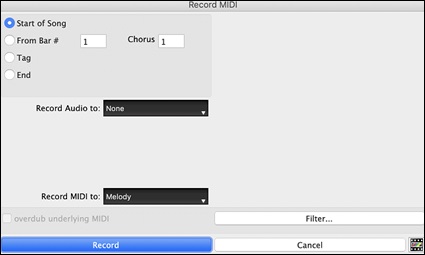
In the Record MIDI dialog, set the start point for the recording and select the destination track. If there are underlying MIDI notes in the destination track, you can choose the option to merge or overwrite them.
The [Filter] button opens the Record Filter dialog. This dialog lets you choose which MIDI information you want to record and which you want to leave out. You can eliminate unnecessary MIDI information or select new MIDI information, like controllers, to add to an existing track.
Click [OK] to return to the Record dialog and press the [Record] button or the control+R keys again to begin recording.
You can stop recording by pressing the esc key or the spacebar, or by clicking the [Stop] button. When the recording is finished, you have several options
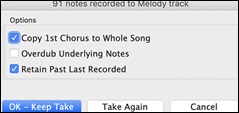
[OK - Keep Take] saves the take that was just recorded.
Copy 1st Chorus to Whole Song: If you have recorded one chorus of the song, checking this at the end of the recording will copy the same recording to all the choruses.
Overdub Underlying Notes: You have the option to merge the recording with existing melody. If there is no underlying melody, this option will be grayed out.
Retain Past Last Recorded: You have the option to keep or erase any melody after the last recorded note.
Step Edit Notes
You can step edit a recorded track or create a new track in the Edit Note/Time Etc., dialog. Select the menu item Melody | Edit Melody Track | Step Edit Notes.
This feature is very useful if you have recorded a good take with just a minor glitch. Rather than scrap the take, you can use the step edit feature to fix the track and save it.
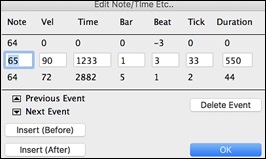
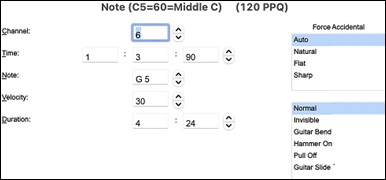
Note: The note is played out through the MIDI driver, so you can hear it. The note is also drawn on the keyboard on the Mixer, so you can see it. Input the MIDI Note Number. There are 128 MIDI notes. Every C note is a multiple of 12, which makes middle C (called C5 for the 5th octave) note number 60. For example, C5 = 60, C#5 = 61, D5 = 62 etc.
Velocity: Type in a velocity to control the volume that the note is played at. Change the velocity to zero to stop a note from being played. Note that you can globally change the volume of a melody track, from the melody pull down menu.
Time: Represents the total time in ticks for the current event from the beginning of the song. At 120 ppq resolution, a quarter note equals 120 ticks and a bar of 4/4 time is 480 ticks. This number includes the lead-in bar of 480 ticks.
Bar, Beat, Tick: The Bar, Beat, and Tick show the time that the note is played. Ticks are the smallest unit, equal to 1/120th of a quarter note.
Duration: This is the length of time that the note is played. 120 ticks of duration = 1 beat (quarter note).
Previous/Next Event: Use these arrow controls to move through the MIDI track one note at a time.
Insert Before/After: This allows you to insert an event before or after the currently displayed event.
[Note: You can get better results by using the Notation window to edit notes instead of this window. To do this, you open the Notation window and mouse click on a note while holding down the option key in Staff Roll or Editable notation mode. ]
Entering Notes Manually
You can enter melody notes directly to the track in the Notation window in either the Editable Notation Mode or the Staff Roll Mode.
You can enter melody notes directly onto a track in the Notation window, using either the Editable Notation or Staff Roll mode. Notes and rests can be entered, moved, and edited with standard mouse actions—point and click, drag and drop, or right-click to open the Note Edit dialog. Confirmation dialogs help prevent accidental entry of duplicate notes (same pitch near the same time) or notes that are extremely high or low (requiring many ledger lines.
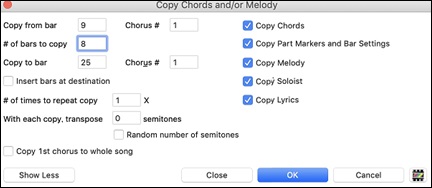
You can copy melodies in a range of bars and paste them to another bar. Select Edit | Copy Special | Copy From.. To .. or press option+C to open the Copy Chords and/or Melody dialog. The dialog allows you to specify the location to copy from, the number of bars to copy, the location to copy to, and the option to copy any or all of the chords, melody, and/or soloist.
Recording with the Wizard Feature
This is a very helpful feature if you do not have a MIDI keyboard, but you want to record with a “live” feel. Use the Wizard to record notes from the computer’s QWERTY keyboard for a track that is more natural than step time.
Here is how it works:
1. Click on the [MIDI] button on the top toolbar and check MIDI Keyboard Wizard Enabled. You can also press option+W.
2. Press the [REC] button on the top toolbar or the hotkey Ctrl+R, and press [Record] in the Record MIDI dialog.
3. As the song plays, play the melody on any keys on the bottom two rows of the QWERTY keyboard, in the rhythm of the melody. The “wizard” notes will not be the correct melody of course, but don’t worry about that as you record. When you are finished, look in the Notation window. You will see notes in the right places and with the correct durations, but with the wrong pitches.
4. Drag the notes with the mouse and drop them on the correct place on the staff. You will hear the notes play as you drop them, and the names will show in the note name box. For sharps, flats, and naturals, hold down the shift key, control key, or command key respectively. You will end up with a melody that sounds like it was recorded live, without the rigid feel of tracks entered in step time.
[Tip: If you have the wizard on, the spacebar will not stop playback. You need to press [Esc] key to stop playback when the Wizard is on. This is to prevent stopping the song inadvertently if you mistakenly hit the spacebar while playing the wizard.]
Importing MIDI Files
Standard MIDI files can be read to your song from MIDI files or from the clipboard. You can read in all of a MIDI file, or selected channels and a specific range of bars. Use one of the following two commands:
- Melody | Import Melody from MIDI File to select a MIDI file from disk using the file dialog.
- Melody | Import Melody from Clipboard - when the MIDI data is already copied from another program to the clipboard.
Once chosen, the Import MIDI File dialog box opens.
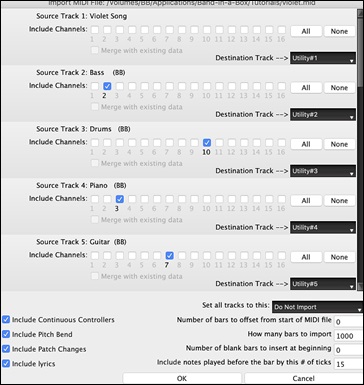
Include Channels: You can hover the mouse cursor over the channel selector check boxes to see how many events are on each channel. If you select all of the channels, Band-in-a-Box will read in all of the channels and merge them to the destination track.
Merge with Existing Data on the track: You can choose to merge the imported data with the existing data in the destination track.
Destination Track: You can choose the destination track for each track for multi-track MIDI files.
Set all tracks to this: This allows you to set a destination track for all source tracks.
Include Continuous Controllers / Include Pitch Bend / Include Patch Changes / Include Lyrics: If you don’t need these items, you can save space by not importing them.
Number of bars to offset from start of MIDI file: If you want to start reading from the beginning of the MIDI file, select 0 as the offset. If you want to start at bar 32, for example, select an offset of 32 (bars).
How Many Bars to import: Leave this setting at the default of 1000 to read-in the entire file (unless it’s longer than 1000 bars!), or set it to the number of bars that want.
Number of blank bars to insert at beginning: This will insert blank bars into the track. Remember that Band-in-a-Box normally has a 2-bar lead-in count. If your MIDI file has no lead-in, then you need to set this to = 2 to compensate for the 2 bars of lead-in.
Include notes played before the bar by this # of ticks: If you’re reading in a MIDI file starting at bar 5, it would be annoying to have a note that was played 1 tick earlier than bar 5 left out of the MIDI file that is read in. To include it, you can set this, and the note will be read in.
Editing MIDI Tracks
Quantize Track
In the Mixer, right-click on a track and go to Edit MIDI | Quantize, Time Adjust | Quantize. This allows you to quantize the MIDI track.
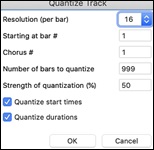
Resolution: Choose the division you would like the track quantized to. Choosing 16 will quantize to 16th notes.
Starting at bar# / Chorus #: Quantization will begin at the place you select and applied for the number of bars.
Number of bars to quantize: Leave at 999 to quantize the entire track or specify 1 or more bars.
Quantize durations %: Choose 100% if you want the notes quantized exactly to the division. Otherwise, the notes will be moved the % toward the target quantization.
Quantize start times: By default, this option is set to true. If you do not want the beginnings of the notes quantized, set it to false.
Quantize durations: This quantizes the END of the notes. By default, this is set to off.
Humanize Track
Quantize routines can leave the music sounding stiff and unmusical. Some routines attempt to humanize a track by adding “randomization,” which rarely has the desired effect since humans don’t randomly change timing or volume. Band-in-a-Box uses intelligent humanization routines to humanize a melody from one feel to another, from one tempo to another, and vary the amount of swing to 8th notes. The results are very musical, with natural sounding melodies.
.Right-click on a track label in the Mixer or Tracks window, and select Edit MIDI | Quantize, Time Adjust | Humanize from the context menu
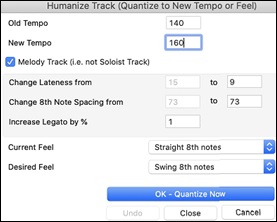
We have broken down the Humanize effect into 5 main categories: tempo, lateness, 8th note spacing, legato, and feel. The best way to learn how these parameters combine is to try them (you can always press the [Undo] button if you don’t like the results.)For example, try changing the tempo of a song to see the changes that this will make to the 8th note spacing and lateness. Press the [OK - Quantize Now] button to apply your changes to your song.
[Tip:Often, when musicians play at faster tempos they play the swing 8th notes closer together and a little late.]
We feel that these categories are straightforward and you should have no trouble achieving the desired results. Remember to apply such parameters as Legato and Lateness sparingly, then press the OK button to apply your changes to your song.
Event List Editor
You can edit events including all MIDI events and lyric events using the Event List Editor. It can be launched in several ways.
- Choose the meu item Melody | Edit Melody Track | Step Edit Melody.
- Choose the meu item Soloist | Edit Soloist Track | Step Edit Soloist Track.
- Choose the meu item Window | Notation | Event List Editor.
- Press the [Events] button in the Notation window.
- Right-click on a track label in the Mixer or Tracks window, and select Edit MIDI | Event List Editor from the context menu.
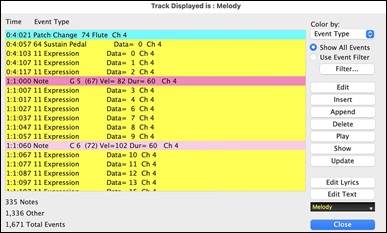
The list uses a color-coding based on Event Type, Channel, Duration, or Velocity.
If the color-coding is based on “Event Type,” the list shows the event as follows.
- Notes starting near the beat boundary are dark pink.
- Notes starting on the offbeat are light pink.
- Patch changes are cyan.
- Controller changes are yellow.
- Pitch Bends are grey.
The Event List Editor allows you to modify, insert, and delete notes.
- Double-click on an event to edit it (or press the [Edit] button).
- [Insert] puts an event before the current event.
- [Append] puts an event at the end of the track.
- [Delete] removes an event.
- [Show] exits the dialog and highlights the note in the Notation Window.
- [Play] plays the current event moves the next event.
- [Update] redraws the notation screen.
- [Edit Lyrics] allows you to edit note-based lyrics.
- [Edit Text] is for editing text events.
Event List Filter
There is a filter for the Event List Editor, allowing you to quickly spot all patch changes.
For example, to examine the patch changes on the Melody track, choose Use Event Filter, and then press the [Filter] button.
In the Event List Filter, select the type of information you want to display. In this case, it is program changes (patches) only.
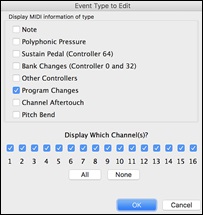
The track will then display with the program changes only.

|
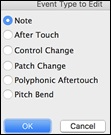
The Event Type to Edit dialog opens when either the [Insert] or [Append] buttons are pressed in the Event List Editor. This dialog allows you to select which type of event to insert or append - note, controller, pitch bend, etc. – and then opens the selected edit dialog. |
Notation Window Editing
You can often get better results by using the Notation window to edit notes instead of the Event List window. To do this, open the Notation window in either Editable Notation or Staff Roll Notation mode. In both modes, notes can be dragged and dropped with the mouse.
For precise note editing, right-click on the note you want to edit and choose “Edit Note” in the contextual menu. This opens the Note dialog where all of the parameters of the note can be addressed.
Timeshift Melody
In the Mixer, right-click on a track label and go to Edit MIDI | Quantize, Time Adjust | Timeshift Track (ticks). This will move (slide) the track a certain number of ticks. There are 120 ticks per quarter note. For example, to give the song a more laid-back feel, shift the track about 10 ticks ahead.
Insert Beats/Delete Beats
IYou can insert or delete a specified number of beats in the MIDI track. For example, to insert 2 bars at bar 5, right-click on a track label in the Mixer, go to Edit MIDI | Quantize, Time Adjust | Insert Beats at Bar…, select bar 5, and select 8 beats (2 bars) to insert.
More Editing Features
More MIDI editing features are available in the Edit MIDI submenu of the track label’s right-click menu. For example, you can transpose the track without affecting other tracks, eliminates note overlaps, copy MIDI data in the first chorus to all choruses, erase all MIDI data from the track, and more.
Piano Roll Window
The Piano Roll window enables precise graphic editing of note timing and duration. You can also graphically edit note velocity, controllers, program changes, channel aftertouch, and pitch bend.
 To open the Piano Roll window, click on the [Piano Roll] button on the side toolbar. control+clicking on this button opens it as a floating window, while shift+clicking adds it as an embedded window.
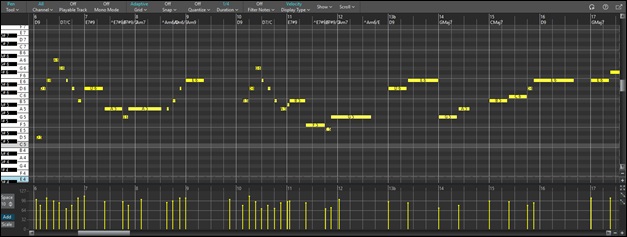
[Note: A demo song PianoRollDemoSong.MGU in the Band-in-a-Box/Tutorials/Tutorial – BB2020 folder contains some MIDI data, which can be seen in the Piano Roll window.]
Toolbar

Tool
Choose from different editing tool modes to optimize your workflow for different tasks. “Pen” is the default tool, streamlining the note entry for faster composition. The “Split” tool lets you divide a note into two at the click point. The “Right-Click” option lets you configure right-click behavior. By default, right-click dragging selects notes. You can also switch tools by hotkeys 1-6 (1 - Pen, 2 - Select, 3 - Move, 4 - Split, 5 - Erase, 6 - Velocity).
Channel
Choose which MIDI channel's events to display.
When "All" is selected, events on all channels in a multi-channel track are shown.
When "10" is selected, Note and Keyboard panels display the drum sound name associated with each key (e.g., "C5 (Kick)") alongside the standard note name, making drum programming more intuitive.
When a channel from 11 to 16 is selected, Note and Keyboard panels display guitar string and fret information (e.g., "C5 (2s/1f)" for second string, first fret) alongside the standard note name, enhancing guitar-oriented MIDI editing.
Playable Track
Enable or disable the Playable Track. When enabled, any note you enter will be heard during playback unlike RealCharts notes.
Mono Mode
When Mono mode is on, only one note plays at a time. This is ideal for creating melodic sequences and single-note lines without unintended chord overlaps.
Grid
Toggle the grid on/off, adjust the grid resolution to match your workflow, or apply swing or groove to the grid for non-straight timing feels.
Snap
Adjust snap behavior, including snap strength and toggle.
When the Snap mode is on, selections, inserted notes, or edited notes will align to the selected note value.
The hotkey (shift+S) toggles the Snap mode on and off.
The "Strength" option (0-100%) lets you fine-tune how strongly notes adhere to the grid, enabling subtle timing shifts while still maintaining a loose rhythmic feel when desired.
Quantize
This provides quick quantize strength presets (0-100%) or opens the full Quantize dialog, which offers precise and flexible control over timing and musical alignment.
In the Quantize dialog, click on a quantize type button (Time, Scale, or Velocity) to enable or disable that quantize type.
- Time: Align note positions to the desired timing resolution.
- Scale: Adjust notes to a selected musical scale.
- Velocity: Normalize or modify velocity ranges.
Duration
Set the default duration of inserted notes. You can easily adjust individual note durations with the mouse, so typically you only need to choose a standard duration that fits your song.
Filter Notes
This lets you toggle note filtering on or off and provides advanced filtering options.
The Note Filter Settings dialog provides sophisticated note filtering capabilities.
- [Pitch Range]: Show or hide notes by pitch.
- [String Range]: Show notes within specific guitar string ranges.
- [Fret Range]: Show notes within specific fret ranges.
- [Position Range]: Filter notes by time range using the bar.beat.tick format.
- [Duration Range]: Display notes based on note length.
- [MIDI Channels]: Show or hide notes by channel, with convenient All/None buttons.
- [Velocity Range]: Filter by velocity ranges.
- [Invert Filters]: Swap visible and hidden notes instantly.
- Enable or disable each filter criterion independently by clicking on the filter button.
- Selection rectangle respects filters, with an option to select filtered notes.
Display Type
This determines which graphic data is displayed or edited in the Graphic Event panel. You can choose Velocity, Controller, Program Change, Channel Aftertouch, or Pitch Bend.
Show
This lets you select visual features including:
- Crosshairs: These are the faint dotted horizontal and vertical lines that follow the mouse as you move it in the Note panel.
- Middle C Indicator: A clear visual marker highlights Middle C (C5) for easy octave orientation.
- Ghost Notes: When viewing a single channel, notes on other channels are displayed, helping you follow multi-channel tracks.
- Velocity Shading: Notes are color-coded by velocity, with higher velocities appearing brighter and more saturated, and lower velocities appearing more subdued.
- Note Display: Choose what information appears on each note (note name, velocity, duration, etc.).
- Keyboard Note Names: Display MIDI note names on the piano keyboard for quick reference.
Scroll
The "Mouse Scroll" option allows you to enable or disable mouse wheel scrolling, giving you control over navigation behavior.
When the "Auto Vertical Scroll" option is enabled, the Piano Roll automatically scrolls vertically as you switch tracks to keep the average note range in view.
Reset Button
This restores all settings to their default values.
Help Button
This opens the help file for the Piano Roll window.
Floating/Docking Button
This toggles between floating and docking modes.
Cursor Location Info Panel

This panel shows the cursor's location in bar.beat.tick format, along with the corresponding MIDI note or controller value (depending on the cursor position).
Piano Keyboard Panel
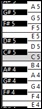
The piano keyboard displays MIDI note names for quick reference. This is enabled by default via the Keyboard Note Names option in the [Show] drop-down menu.
Clicking on a key inserts a note at the cursor with the duration set in the [Duration] drop-down menu.
Holding a key inserts a note at the cursor with a duration determined by how long you hold the key.
shift+clicking on a key selects all notes of that pitch.
shift+dragging across the keyboard selects all notes within a pitch range.
Note Panel
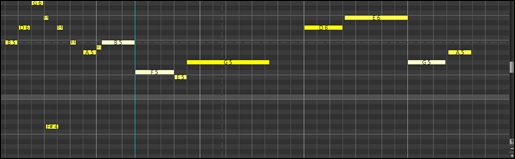
This panel displays two distinct full-height cursors: a green playback cursor that tracks the current playback position, and a blue position cursor that marks your edit/start position.
Faint dotted horizontal and vertical lines appear as you move mouse.
A clear visual marker highlights Middle C (C5) for easy octave orientation.
Zoom in vertically down to a single octave for detailed editing of specific pitch ranges, or zoom out to display all notes within the visible window height.
Zoom fully out horizontally to view your entire project at once, ideal for reviewing overall song structure and long-range patterns.
Horizontal bars represent notes. Notes can be selected, edited (start time, pitch, duration), inserted, and deleted.
Notes are color-coded by velocity, with higher velocities appearing brighter and more saturated, and lower velocities appearing more subdued.
When viewing a single channel, notes on other channels are displayed in while, helping you follow multi-channel tracks.
Notes display information such as note name, velocity, duration, etc. You can choose what information appears using the [Show] drop-down menu.
Note text automatically shortens when notes are too small to display full information, maintaining readability at all zoom levels.
Detailed tooltips appear when hovering over any note, showing pitch, velocity, duration, position, channel, and more. When hovering over empty space, the tooltip shows what note would be created at that location.
Overlapping notes are displayed in white for easy identification. They can be eliminated from the context menu.
Note Selection
Click on a note to select it. The selected note will be shown in red.
shift+drag over notes to select multiple notes.
shift+click on a note to add it to the selection.
Holding down the shift key while pressing the left/right arrow selects the adjacent note to the left or right.
In the “Select” Tool mode, click on empty space and drag a rectangle around notes to select all notes within that rectangle.
The selection rectangle picks up all notes that overlap with the rectangle, not just those whose start positions fall within it, making multi-note selection more intuitive.
Adding Note
In the “Pen” Tool mode, click anywhere on the Note panel to enter a note with the duration set in the [Duration] drop-down menu.
Pressing the N key inserts a note at the cursor position using the last-entered pitch.
To add notes with custom durations, click and drag horizontally. Notes will extend as you drag, with real-time visual feedback.
Clicking on a key in the Piano Keyboard panel adds a note at the current cursor position.
If Snap mode is on, inserted notes will align to the selected note value.
Editing Note
Click and drag a note horizontally to adjust its start time.
The left/right arrow keys move the start time of the selected note by 1 grid resolution.
Click and drag a note vertically to adjust its pitch.
The up/down arrow keys move the selected note by one semitone.
Holding down the shift key while pressing the up/down arrow keys moves the selected note up or down by one octave.
Click and drag from the right edge of a note to adjust its duration.
Click and drag from the left edge of a note to adjust its start time and duration simultaneously.
When moving a note with the arrow keys, note movement follows the current grid resolution, providing more predictable and musically aligned navigation.
By default, note movement is axis-locked—restricted to pitch or time—for precise editing. Hold the shift key while dragging to remove the lock and move notes freely in both directions.
Select a note and press the delete key to delete the note. Clicking on a note while holding down the shift+control keys also deletes the note. If “Erase” is enabled in the [Tool] drop-down menu, clicking on a note deletes it.
Hold down the control key as you hover over a note. When the cursor changed to a “V” click and drag the note vertically to adjust its velocity.
The current velocity value is displayed in real time as you drag.
Hold down the control key while hovering over a note. When a specialized cursor (“V”) appears, click and drag the note vertically to adjust its velocity. The current velocity value is displayed in real time as you drag.
Graphic Event Panel

This panel displays non-note MIDI events such as Velocity, Controller, Program Change, Channel Aftertouch, and Pitch Bend. Use the [Display Type] drop-down menu to choose which type of data is shown.
When inserting controller or pitch bend events graphically, the event density can be adjusted from one event per tick up to one event per 30 ticks.
For events like Pitch Bend or Controller (e.g.,modulation or sustain), always end a “gesture” with a zero-value event. Otherwise, subsequent notes may be affected, causing unwanted effects such as a lingering pitch bend, continuous vibrato, or a stuck sustain pedal.
Velocity
You can increase or decrease velocities of the selected notes using hotkeys or the context menu.
| (Hotkey) | (Context menu) |
+ |
Increase Velocities of Selected Notes by 1. |
shift + |
Increase Velocities of Selected Notes by 5. |
- |
Decrease Velocities of Selected Notes by 1. |
shift - |
Decrease Velocities of Selected Notes by 5. |
~ |
Randomize Velocities of Selected Notes (-1 to +1). |
shift ~ |
Randomize Velocities of Selected Notes (-5 to +5)). |
You can also adjust velocities directly on the Note panel. To do this, hold down the Ctrl key while hovering over a note, and when a specialized cursor (“V”) appears, click and drag the note vertically.
Controller

The Graphic Event panel displays the chosen controller type such as:
- Expression MSB: This is recognized by most modern synthesizers including most General MIDI synths. However, some older synths do not recognize this controller. Expression is an alternative to “7 Main Volume MSB.” Use the Expression controller for individual tracks and reserve the main Volume controller for overall track loudness. That way, you can use the Band-in-a-Box main window Volume controls without affecting individual notes on the track.
- Modulation Wheel MSB: is not firmly defined, but it is usually a Vibrato or Tremolo effect (especially in General MIDI synths). Play PianoRollDemoSong.MGU and watch how Modulation has been added to some notes to add Vibrato. It is usually best to use a modest amount. With graphic edits, too much is almost always too much!
Program Change

The demo song intro has a flute program change. Then the first chorus is trumpet, the second chorus is flute, and the third chorus is soprano sax.
Channel Aftertouch

Select "ChnAfter" in the [Display Type] drop-down menu to see Channel Aftertouch events.
Pitch Bend

Play the demo song and watch how the pitch bends have been inserted to "scoop" some note attacks, "sting" the middle of a note, or "fall off" some note releases.
Event Selection
Click on an event to select it. The selected event will be shown in red.
shift+drag over events to select multiple events.
shift+click on an event to add it to the selection.
Adding Events
Click on the desired location to insert a single event.
Use the Pencil or Line tool to add multiple events at once.
Pencil Tool: Hover the mouse cursor over an empty area to activate the Pencil tool. Then, click and drag to draw a freehand curve. If the curve isn’t perfect on the first try, keep holding the mouse button and move back and forth until it matches your desired shape. Releasing the mouse inserts a series of events following the freehand curve.

Line Tool: Hold down the control key while hovering the mouse cursor over an empty area to activate the Line tool. Then, click and drag to draw a straight line. Releasing the mouse inserts events along the line slope.

For both tools, the Space setting controls the spacing of inserted events. For example, setting it to 30 inserts events every 30 ticks.
Edit Modes
There are two modes for editing graphic events.
- The Add mode adds or subtracts the same amount to all selected events.
- The Scale mode scales the selected events. Select one or more Graphic Events and move the mouse over one of the events. shift-drag vertically, and the events are scaled in a proportional fashion. Large-value events are scaled more than small-value events. This keeps the same shape of a gesture but makes the gesture bigger or smaller.
In the Add mode, note velocities exactly match the slope of your drawn line.
In the Scale mode, the Line Tool shapes the dynamics, but note velocities are scaled to follow the approximate shape of your drawn line. With this mode, you can insert a velocity fade, or change the velocity of a region, while preserving the Velocity dynamics of the music.
Editing Events
Click and drag an event up or down to change its value. If multiple events are selected, the values of all selected events will be changed.
Hold down the shift key while clicking and dragging an event horizontally to slide it in time. If multiple events are selected, all selected events will move together.
Select an event and press the Delete key to delete the event. Clicking on an event while holding down shift+command also deletes the event.
Right-Click Context Menu
Right-click in the Note, Graphic Events, or Ruler panel to access the context menu.
Undo : Duplicates the Band-in-a-Box Edit | Undo (or command+Z) action.
Delete Selected Events : Deletes any selected events (highlighted in red). This can also be accomplished by tapping the delete key.
Select All Notes and Graphic Events - If the “Chan” combo box is set to “All,” this item will select ALL EVENTS on ALL CHANNELS (all events in the track). Otherwise, ALL EVENTS are selected which match the CURRENT MIDI CHANNEL.
Select All Note Events (Of Current Channel) (right-click the Note Panel or Note Ruler) : If the Chan combo box is set to All, this item will select ALL NOTES on ALL CHANNELS, but it will not select any non-note events. Otherwise, ALL NOTES are selected which match the CURRENT MIDI CHANNEL.
Select All Note Events (Of Current Channel) (right-click the Graphic Event Panel or Graphic Event Ruler) : If the “Chan” combo box is set to “All,” this item will select ALL GRAPHIC EVENTS of the CURRENT VIEW/EDIT TYPE on ALL CHANNELS. Otherwise, ALL GRAPHIC EVENTS of the CURRENT VIEW/EDIT TYPE are selected which match the CURRENT MIDI CHANNEL. For instance, you could select all channel 4 modulation events, then Delete, to easily remove all of those events from the track.
Cut : Copy selected events to the clipboard and then remove them from the track. Can also be accomplished with the menu Edit | Cut (or command+X) action. If you wish, it is possible to cut from the Piano Roll, and then paste into the Notation window, or vice-versa.
Copy : Copy selected events to the clipboard can also be accomplished with the menu Edit | Copy (or command+C) action. If you wish, it is possible to copy from the Piano Roll, and then paste into the Notation window, or vice-versa.
Paste : Replace (If no events are on the clipboard, this item is dimmed.) - The paste occurs at the time location of your right-click. Move the mouse cursor to the desired insert location. Right-click on the Note Panel, Graphic Event Panel, or any of the Rulers. Then choose this item from the pop-up menu. Any previous event types in the paste range which match event types in the clipboard are removed before the clipboard data is added to the track.< If the “Chan” combo box is set to “All,” pasted events keep their original (copied) MIDI channel. Otherwise, the pasted events will be re-channeled to match the “Chan” combo box.
Paste - Merge (If no events are on the clipboard, this item is dimmed.) : The paste occurs at the time location of your right-click. Move the mouse cursor to the desired insert location. Right-click on the Note Panel, Graphic Event Panel, or any of the Rulers. Then choose this item from the pop-up menu. Events from the clipboard are merged with existing data in the track. If the “Chan” combo box is set to “All,” pasted events keep their original (copied) MIDI channel. Otherwise, the pasted events will be re-channeled to match the “Chan” combo box. The feature can also be accomplished with the menu Edit | Paste (or command+V) action (to match the Notation window, which also uses a merge style of pasting). Before using the main menu Edit | Paste (or command+V), first make sure the insertion marker is set to your desired paste time location. This is easy to do. Just click or drag in the Chord Ruler to place the insertion marker where you want it. Then tap command+V.
Re-Channel All Events to the Track Channel (Ch = xx) : Re-channel all notes and graphic events (the entire track) to the MIDI Output channel assigned for this track. Sometimes this can come in handy to bring some “sanity” into Piano Roll editing. For instance, though the default Melody output channel might be channel 4, meaning that Band-in-a-Box transmits any events in the Melody track on channel 4. The actual events in the Melody track might be channel 1, or a mixture of several channels. For ordinary playback or note tweaking, it doesn’t matter if the event channels are “mixed up,” as long as you have the view channel set to All. But if you wish to use Paste - Replace, the Paste - Replace function is smart enough not to “stomp on” a track’s events that differ from the channels of the clipboard MIDI data. So if you force all events to the track channel, the Paste - Replace function will always replace appropriately.
Re-Channel Selected Events to the Track Channel (Ch = xx) - Re-channel only the selected events to the track channel.
Re-Channel Selected Events to the View Channel - When editing a multi-channel guitar part or editing an imported multi-channel MIDI file, this command may be useful. Beware that it might initially appear confusing. For instance, one might set the view channel to ALL, and make a selection (intending to set these events to Ch 12). Then set the view channel to 12, and of course the selected events disappear (if the events had some other MIDI Channel). But then when you invoke “Re-Channel Selected Events to the View Channel,” the MIDI events will reappear on the Piano Roll.
Eliminate Overlapped Notes : Overlapping notes are displayed in bold aqua color, making them easy to identify. Selecting this menu command will remove the overlap.
Create Mute Region to mute generated accompaniment : This menu item is available in the Playable Track mode. When you select this, a green label will show at the top, and you can extend it by dragging horizontally. When you play the song, the generated accompaniment in this region won’t be heard, but the green notes you have entered will be heard. If you regenerate accompaniment, it will be outside of this is region.Increase Velocities of Selected Notes by 1: This increases velocities of all selected notes by 1. The hotkey is + (plus).
Increase Velocities of Selected Notes by 5 : This increases velocities of all selected notes by 5. The hotkey is shift++.
Decrease Velocities of Selected Notes by 1 : This decreases velocities of all selected notes by 1. The hotkey is – (minus).
Decrease Velocities of Selected Notes by 5 : This decreases velocities of all selected notes by 5. This The hotkey is shift+-.
Randomize Velocities of Selected Notes (-1 to +1) : This changes velocities of all selected notes by a random number from -1 to +1. The hotkey is ~ (tilde).
Randomize Velocities of Selected Notes (-5 to +5) : This changes velocities of all selected notes by a random number from -5 to +5. The hotkey is shift+~.
Unconditional 30-Day Money Back Guarantee on all PG Music products purchased from PG Music Inc.
PG Music Inc.
29 Cadillac Ave Victoria BC Canada V8Z 1T3
Sales: 800-268-6272, 250-475-2874,+ 800-4746-8742*
* Outside USA & Canada where International Freephone service is available.
Access Codes
Tech Support: Live Chat, support@pgmusic.com
 Online now
Need Help?
Customer Sales & Support
|
Phones (Pacific Time) 1-800-268-6272 1-250-475-2874 |
||
| Live Chat | ||
| OPEN | Online Ordering 24/7 |
|
| OPEN | Forums, email, web support |